Thursday, 20 October 2016

Qadamgah-Maula Ali In Hyderabad (Pakistan)


Interior View of Qadamgah-Maula- Ali In Hyderabad Sindh  
        
Dr.Mazhar Naqvi
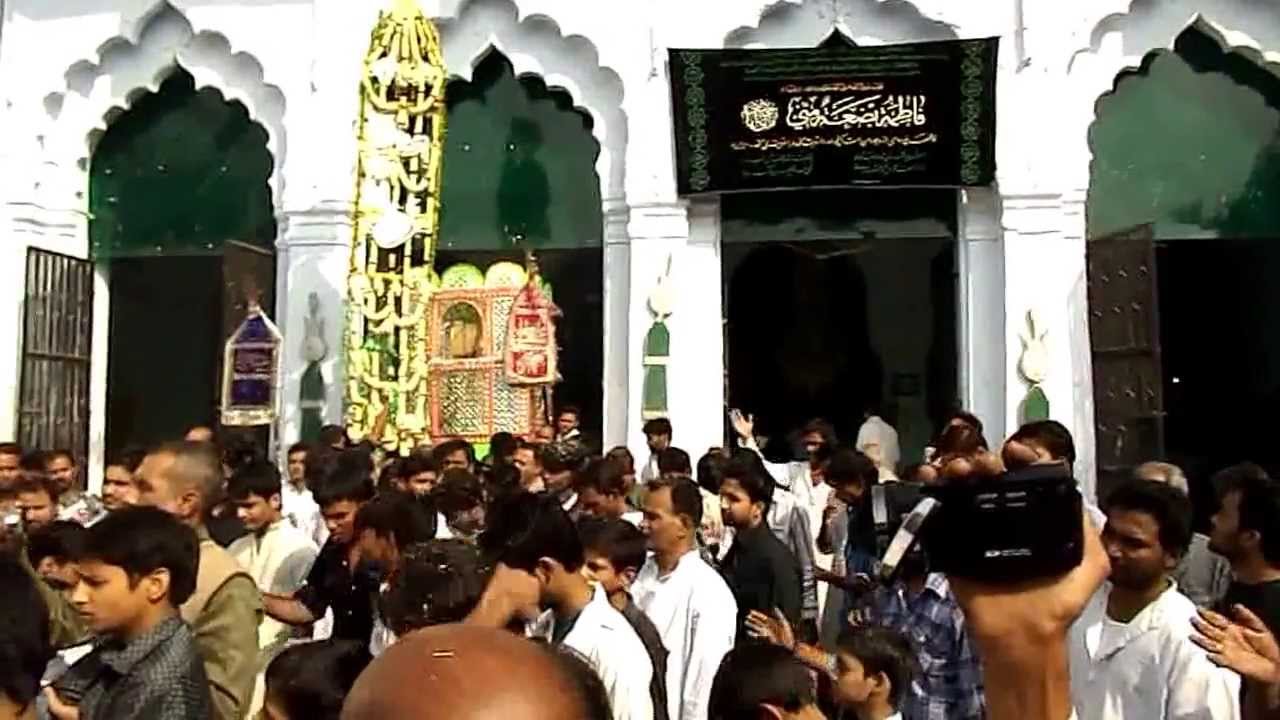
Like India, Pakistan too has a very popular and revered shrine dedicated to Maula Ali in Hyderabad Sindh. The shrine contains hand and foot Print of Maula-e-Kaynaat Hazrat Ali on a rock stone. Among the locals, the place is known as  Maula Ali Qadam. History records that Nizam of Hyderabad Deccan originally had the rock stone. He had acquired the relic during his journey to Iraq. The Nizam was informed by the people of Iraq that once Maula had offered namaz on the stone and  it had turned soft like wax after his prostration. (Sijdah).Out of his sheer love for Maula-E-Kaaynat, he brought the relic to India. As Hyderabad Deccan already had hand and foot prints of Maula Ali on a hilltop, Nizam gave the relic to ruler of the Sindh Ghulam Shah Kalhoro who installed it near his fort to enable people to have its ziarat. Now a  beautiful shrine  houses the slab and devotees visit the holy complex regularly. The gesture of Nizam blessed Hyderabad Sindh also with the relic associated with Maula Ali whose another popular name is Hyder also. While Indian Hyderabad had acquired hand and foot print of Maula Ali in the middle of 17th century following his appearance on the hilltop. His appearance was witnessed by an influential eunuch in a dream. He strived to locate the place saw by him  and finally reached the place where he had seen Maula sitting on a rock. He found the rock with hand and foot print and preserved it in a simply erected shrine. With the passage of time, shrine became quite famous and it still holds considerable popularity among devotees.     
On the other hand, Hyderabad Sindh though named after Maula Ali had no such relic. The vacuum filled with the presentation of relic by Nizam to Ghulam Shah who had ascended throne in 1757 and died in 1772. Since then, it is a popular place of pilgrimage. Shrine of Sindh is not on a hilltop but it is erected on a raised platform. It is richly decorated as well. People assemble there in large number as Sindh has traditionally been a lover of Ahle-Bait-E-Athar.(References available on request.Photo Courtesy Google Images)

Sunday, 16 October 2016

‘Maqtal al-Hussain'-A Brief History


Cover Page of A Translated Version of Maqtal
Published by Imamia Mission-Pakistan


Dr.Mazhar Naqvi
 The term ‘Maqtal al-Hussain’ refers to  the title of various books written by different authors to narrate the tragic martyrdom of Hazrat Imam Hussain and his followers at Karbala in 680 AD. These books were written by renowned scholars in different centuries and serve as a base material for recalling the oppression and atrocities committed on the grandson of the Holy Prophet. Orators, Poets and writers use these books for references and  prepare their Majalis in the light of incidents narrated in them. History records that the first such book was written in 8th century by Abi Mikhnaf who had breathed his last in 157 AH. The other famous Maqtal Al Hussain were written by Ibn Saad in 230 AH,Baladhuri in 283 AH, Ibn Adham in 314.Maqtal written by Dinawari is available but no one has idea about the date of its compilation.
Several other Maqtals were also written between 2nd to 4th Hijri years and their names are found in other relevant works .But they have failed to survive and are no longer traceable. The constant persecution of Shias by the rulers resulted in their permanent loss. Some of the Maqtals lost forever include the works of  Muhammad bin Amr Waqidi (d. 207 or 209 AH), Abu ‘Ubaydah Mu‘mmar bin MuthannĂ  (d. 209 AH, Nasr bin Muzaham Manqari (d. 212 AH, Abi Ubayd Qasim bin Salim Hirawi (d. 224 AH), Abi al- Hasan Ali bin Muhammad Madaini (d. 224/225 AH), , Abdullah ibn Muhammad, , Yaqubi, Abi Abdullah Muhammad ibn Zakariyya al-Ghalabi (d. 298 AH) and Abi Abdullah ibn Muhammad ibn Shahanshah Bag.


 Ibn Nadim, Yaqut al-Hamawi and Al Najashi have mentioned the untraceable Maqtals in their works. It is ironical that these Maqtals are no longer available or else they would have served as an authentic source to Karbala narratives. In the absence of lost Maqtals, Karbala narrators rely heavily on the work of Abi Mikhnaf who was the first to write Maqtal al Hussain and deserves salute for preserving the heart rending tragedies struck at KARBALA  on Imam Hussain and his followers. Miknaf belonged to Azd tribe and lived in Kufa. His work is an important source of early Iraqi historical traditions.Tabari too relied heavily on his work to produce his own work. Mikhynaf has presented narratives in abundance with complete details on the basis of of independent enquiries, collection of facts and seeking first hand information.He also used the work of other traditionalists such as, Amir Al Shahi, Rasibi, Mugalid ibn Said, and Muhammad ib Said Al Kalbi.These traditionalists were either senior to Mikhnaf or his contemporaries.(References available on request. Photo courtesy- Google Images )   

Alam Hazrat Abbas & Dariyawali Masjid


Entrance of Dariyawali Masjid -Lucknow
Dr.Mazhar Naqvi

Azadars in Lucknow have a special attachment with Dariyawali Masjid. They love it for its association with the historic Dariyai Alam that is also known as Alam Fateh-Furat. The Alam originates from the Masjid after Maghrib prayers on 8th of Muharram in memory of Hazrat Abbas Alamdar and proceeds to Imambara Ghufraan-Maab. Due to participation of a large number of devotees, the procession ranks as one of the largest in India.
The Masjid was erected by Marhoom Ramzan Ali Khan Sahib on the bank of Gomti river.Now it is located in the middle of road connecting Hazratganj and Teeliwali Masjid in the wake of construction of a new road between the river and Masjid to control flood. Though built by Khan Sahib, it became popular when Dariyai Alam procession began from here in 19th century. Being located on the river bank, people found it call it as Dariyawali Masjid.  

During the reign of   Nawab Asafuddaula, a temporary market used to come up around the Masjid. Craftsmen from all creed and religions used to come to market with beautiful Tazias, Zarihs, Patkas, Perfumes and scents to please their Nawab who used to visit the market and offer gold, silver and gems to craftsmen for their work. With the passage of time, market around the Masjid became a thing of past and today Kazmain is the largest market of items associated with Azadari.


Alam Fateh Furat Originating from Dariyawali Masjid 

Dariyawali Masjid was a simple structure a few years ago. But now it has been renovated and become a beautiful mosque, containing sacred Rauza of Hazrat Abbas (A.S.).While Masjid used to buzz with activities only on 8th of Muharram every year a few years ago, it remains in news now throughout the year. Not only Majalis are held here on regular basis after renovation and expansion, it attracts large number of visitors on each Thursday. It is also used as a point of origin of protests lodged by Imamis concerning their various religious and socio-political issues.(References available on request. Photo by Blogger)      


Saturday, 15 October 2016

Marsiya Writer Mirza Dabeer Needs Fair Treatment


Dr.Mazhar Naqvi
Imamis have not been much fair to Mirza Salamat Ali Dabeer. First, they unnecessarily pitted him against Mir Anees in 19th century India and now paying no attention towards preservation of his work. Although he is better known as a leading  exponent of marsiya writing along with Mir Anees, Dabeer also excelled in the art of other forms of Urdu poetry. Being a Shair-e-Ahlebait, he refrained himself from writing Ghazals but his Salams surely indicates his mastery over ghazal writing. A couplet from one of his Salams exemplify clearly that his poetic skills are comparable to Ghalib. The couplet says “  
“Hurr fida pyaasa jo Shah par ho gaya
Ai salami, qatra tha samandar ho gaya!”
Translation in English:
When the thirsty Hurr (willingly) sacrificed his life for the Shah (Hussain);
(Know) O salami, (O pilgrim) In truth the drop became the entire ocean!


It is indeed strange that Dabeer has remained neglected from the point of research on his work despite having a considerable following in Lucknow during his life time. In the era of Anees and Dabeer, their followers were divided into two formidable groups known as ‘Anneesiye and Dabeeriye’. Though the poets never criticized each other, their followers always tried to establish supremacy of Anees over Dabeer or vice-versa. While much work has been done on Anees, Dabeer remains neglected till date. No complete or  authentic text of Dabeer’s poetry is available and even critical work on him too is buried in the files of literary journals.he has remained ignored even after publication of Maula Shibli Nomani’s great work titled ‘ Mawazana-i-Anis-o-Dabeer’. There is dearth of material even on his son as well who himself was an excellent marsiya writer and trained by his illustrious father. Dabeer surely deserves much better treatment. Born in 1803 in Delhi, he had started reciting marsiya since childhood during Muharram gatherings. He began writing poetry under the tutelage of Mir Zameer. He moved  to Lucknow following its emergence as a great center of Azadari under the patronage of Awadh Nawabs. He found suitable environment in Lucknow and excelled at a time when Anees was considered unparalleled. Research on him is needed because considerable amount of his work has not seen light of the day. His work is a treasure and master piece of elegiac poetry and hence, deserves to be preserved and protected. Such endeavor is also required because of the poor condition of his last resting place in Nakhas area.(References available on request. Photo Courtesy Google Images).      

Wednesday, 12 October 2016

Thirst of Karbala(Al Atash) In Ali Sardar Jafri's Poetry


Ali Sardar Jafri(1913-2000)
Dr.Mazhar Naqvi
Ali Sardar Jafri is famous as a progressive and prolific Urdu writer India has ever produced. He was also a poet, critic and wrote lyrics for silver screen. While his contribution to Urdu literature is widely acclaimed , Jafri’s attempt to turn “Al Atash” ( I thirst), the cry emanating from ‘Khayam-e-Husssaini’( Camp of Imam ) into a universal symbol of distress remains mostly unknown to Imamis. Al Atash reads as under:    
 “Phir Al-Atash ki hai sada
Jesay rijz ka zamzama
Phir raig e sehraa par rawan
Hai ahl e dil ka karwan
Nehr e Furaat atish bjan
Ravi o Ganga khoon chukan
Ae Karbala! Ae Karbala!”
(Again the cry, “I thirst!” is heard
Like a fountain of thundering war hymns.
Again the caravans of people of the heart,
Are moving across the desert sand.
The river Euphrates flows with fire
The Ravi and the Ganges, stream with blood.
O Karbala! O Karbala!)
Born into an aristocratic family of Balrampur on November 29, 1913, Jafri spent his formative years in his native place before taking admission at Aligarh Muslim University (AMU).He drew inspiration from Josh Malihabadi, Firaq Gorakhpuri and Jigar Moradabadi.at AMU, he developed leaning towards communist ideology and expelled from the university in 1936.Plight of Indians touched his heart and he used thirst of Imam Hussain’s camp as a metaphor to highlight  distress of people all over the world.
Today is Shaam-E-Ghareeban. Hussain and his followers have beebn martyred in the day. There is complete silence in ‘Khayam-E-Hussaini’. Children are no longer crying Al Atash even though they were still thirsty. The exhausted, hungry and tired survivors  sat in loneliness and thought not about water but  the loved ones they had lost in the unjust battle on 10th of muharram 61 AH. Since then, Karbala has been a constant source of inspiration to poets and writers to use martyrdom of Imam Hussain and his companions in their literary pursuits to highlight its relevance to modern world that is plagued with evils of all sorts. The blogger thought it appropriate to post Jafri’s similar attempt to mark Shaam-e-Ghareeb. Al Atash has assumed more relevance and significance in the current era as situation has worsened for the mankind despite technological advancement.(References available on request. Photo courtesy Google Images).


Muharram-2016 in Kanpur-A Brief Report

Matami Procession of Anjuman-E-Rizviya Originating from Imambara Muzaffar Ali Khan

Dr.Mazhar Naqvi
‘Yaum-E-Ashura’ was observed with traditional solemnity in Kanpur city-one of the largest Industrial Metropolis of India. As usual, three well- attended Matami processions from Ram Narayan Bazar area remained attraction of the day. Brought out by Anjuman Moin Ul Momneen, Anjuman-E-Rizviya and Anjuman Raza-E- Islam, the three processions witnessed ‘Matam’ by swords, Knives and chains by youths in large number. While Rizviya and Raza-E-Islam adopted a restrained approach towards recital of Nauhas, Moin –Ul-Momneen performed Nauhakhwani at great length. Its Sahab-E-Bayaz Janab Jafar Kazim Sahib recited Nauhas written by Allama Muntasir Zaidpuri and Saba Lucknowi. Devotees wept bitterly when he  began Zaidpuri’s famous Nauha “Hamne dekha jab makan se Tazia Jaate Hue”( When I saw Tazia Moving from home).Similarly Alvida of Anjuman’Mere Ghareeb Alvida,Mere Ghareeb Alvida”( Good Bye My Imam in Distress).
Anjuman-E-Raza-E-Islam recited Nauhas and Alvida written by Mussawair Zaidpuri.Sahab-e-Bayaz Salmi and Sharad recited Nauha “ Uf ye Zul-o-Sitam,Ye Tabahi” ( Oh No, Such Barbarism and destruction)to leave devotees wailing. Then they recited Alvida with wordings “Fatima Zahra Ke Dilbar Alvida”(Good Bye sweet Heart of Bibi Fatima Zahra).Anjuman-E-Rizviya did Nauhakhwani with Nauhas written by Nawab Asar Lucknowi and Basharat Sahib.”Lashe Shah Pe kahti thee,Zainab ye kah Kar alvida, Ab Main Kahan aur Tuma Kahan Ae Biradar Alvida”(Zainab said good bye at the body of king of martyrs, Good bye brother as you have attained martyrdom and I am left to complete your task in Kufa and Damascus)”.Wasi, Ibne Hasan and Nawab Mumtaz Hussain performed Nauhakhwani. All the three processions culminated at Gwaltoli Karbala.

Matami Julus Entering Gwaltoli Karbala 

Other Matami Anjumans like Mohammad Moin Ul-Aza, Panjatani, Zulfiqar-e-Haideri, Abu Tarabiya, Shamsheer Haideri, Aza-e-Hussain,Firdausia, Masoomia and Jafariya also took out Tazia and Alam processions from Gwaltoli, Colonelganjand Chamanganj areas. Tazias from all over city also reached Gwaltoli amidst drumming. Tazia of Badar Ali attracted attention in view of its length and well-trained Muharram drumming. A number of NGOs played effective role in the peaceful observance of muharram ceremonies in Kanpur.(The article is based on personal participation by the blogger himself.Photo Courtesy Google Images )        

Tuesday, 11 October 2016

'Shab-E-Ashur'-2016 at Makanpur


A View of 'Shabe-E-Ashur'2016 @ Makanpur 


Dr.Mazhar Naqvi

The blogger has just returned from Makanpur village of Kanpur Nagar district of India after witnessing ‘Shab-E-Ashur’ ceremonies. Usually, media give coverage of Muharram ceremonies observed in major cities but villages like Makanpur where Muharram is observed with great solemnity and attended by thousands of people are ignored. The blogger has already written in previous posts about unique features of Muharram at Makanpur.Hence, only a few pictures of Shab-E-Ashur,the night preceding 10th of Muharram, are being posted to give an idea to the viewers how Muharram is observed in a village that is famous for the shrine of Hazrat Badi Uddin Zinda Shah Madar

.  
Traditional Tazia of Dargah Sharif at its Chowk


Turbatwala Tazia at Imam Chowk of Ahmed Sher


Tazia at Imam Chowk of Mir Syed Hasan


A View of Devotees Awaiting arrival of Tazias 


A View of Langar-E-Hussaini

Loudspeakers Being used to Play Mournful Tunes in Front of Tazias .


Muharram Drumming Before the Arrival of Tazias Near Dargah Sharif 

Baba Bahadur who has Introduced Ritual of Paikees with Little Girls who are also his Disciples.