Wednesday, 20 November 2019

Muharram and Hindus in Pakistan


Dr.Mazhar Naqvi
Even as the news about the persecution of Hindus in Pakistan keep featuring in World media at periodical intervals, Taziadari and participation in Muharram rituals continues to be popular among them with same zeal and gusto, indicating that they are determined to follow the path shown by Hazrat Imam Hussain i.e.” raise your voice against tyrant, irrespective of his numeric superiority and might. Choose honorable death as compared to an oppressed life”.
Before partition, Hindus used to observe Muharram in large number in undivided India.post 1947, their participation declines in both Pakistan and India. In Pakistan, it was persecution by fanatics and attacks on Muharram processions and Sufi shrines that discouraged them while rise of communalism in India did the same in urban pockets initially and now threatening their rural counterparts as well. However, despite vehement opposition of anti-  Karbala elements, Taziadari and Azadari continue to thrive in both the countries. While in India, Muharram rituals continue to be remaining unaffected in Southern part of the country, the same applies to Sindh province of Pakistan.  
In Karachi, Hindus continue to revere Imam Hussain as they have been doing for generations. Those living in Hindu pockets of the commercial capital of Pakistan  openly admit that had always shown respect towards the great sacrifice of Hazrat Imam Hussain and that they were doing the same even today. They prepare Tazia near their temple with everyone taking part and helping in Muharram ceremonies. For all of them, Yaum-e-Ashura is big occasion.
 Hindu Tazias of Ranchor Line Karachi
Duldul Tazia of Ranchor Lines in Karachi is historic. It is integral part of Muharram procession. It is taken out jointly by Hindus and Sikhs. Sandeep Singh, one of the organizers reveals that Tazia is taken out as a symbol of fulfillment of a vow by his grandfather. The family has been in the procession since 1965 after Sandep’s grandfather who was blessed with children after remaining issueless for considerable time , prompting him to go for vow before another Tazia dedicated to the sacred memory of Imam Hussain. Hindu women cleaning streets for Ashura procession is another unique feature of their devotion to Imam. The men who make these Tazias have been doing this for at least three generations from Hindu-dominated Narainpura area.
In Hyderabad Sindh, One Ashura procession is taken out by Hindus from the Sheikh Muhalla.
In Peshawar, the Hindu community believes that Muharram symbolizes  inter-religious harmony as there was no aversion, no instability and everyone would observe it irrespective of their religion and sectarian differences. The local residents’ recall that participation of Hindus was more about three decades ago but now tradition is slowly but surely shrinking. They attribute the education system of Pakistan to the trend. Babaji Guru Gurpal Singh, while reminiscing on the past, tells that people of all faiths would attend the procession. Now admirers of Imam Hussain with non-Muslim background they  avoid being part of the procession in view of stringent security measures introduced during Muharram.  To keep the tradition alive, Baba has formed  a ‘Muttahida Aman Committee’ and its members visit different Imambargahs and offer their help to the mourners”. The committee also visits the places and assists those who want to establish Tazia processions in their areas.
In Pakistan, participation of Hindus in Muharram can still be observed in areas like Tando Muhammad Khan, Mir Pur Khas, Sanghar, Umer Kot, Tharparkar, Badin, Thatta and Dadu besides others .Hindu in these areas refrain from marriage ceremonies during Muharram, wear black clothes as symbol of  mourning, distribute ‘Langar’ and even hoist the Alam  to pay tributes to Commander of small band of Hussaini force, Hazrat Abbas Alamdar. It is nothing less that a miracle the way Hindus come out on the streets to observe Muharram in Pakistan- a country marred with sectarian violence.

Sunday, 17 November 2019

Hindu Hussaini Poets of India

Dr.Mazhar Naqvi 


"Na Cheez Hun Main, Qaabil-e-Touqeer Nahi
Taqreer Meri Layeq-e-Tehreer Nahi
Kafir Kaho, Mushrik Kaho, Jo Kehna Hai Kehdo
Hindu Hun Magar Dushman-e-Shabbir  Nahi"  


These lines in praise of Hazrat Imam Hussain has not been composed by any Muslim but by a Hindu poet  Gopi Nath Aman. He is not the only one of his kinds as history records many a Hindu poets and writers eulogizing the sublime sacrifice of Imam for the sake of humanity.Their passion for Hussaini poetry exemplifies the message of Islam and Karbala is not for one religion but its appeal is universal and will be kept alive till the fight of right and wrong, evil and virtue and Good and Bad continues in the world. 

One of the most important events in early Muslim history was the battle of Karbala fought in 680 CE with Imam Hussain, grandson of the Holy Prophet (PBUH) sacrificing  his life along with a small band of disciples in a bloody battle against the tyrant Yazid. Since then innumerable pens irrespective of caste,creed and religion, has been recalling his martyrdom in poetic beauty in the form of Marsiyas,Soz,Nauhas,Salam and Qatas. 

“Marsiya” is usually associated with the Muslims who use to recite Marsiya and Nohe during the Month of Moharram to remember and pay tribute to the Ahle Bayt e Rasool (SAW) who sacrificed their lives in Karbala with bravery. But it is amazing to observe that beside many noted Muslim Marsia Nigars the people of other religions also wrote beautiful and inspiring Marsiya.
Marsiya found a congenial soil in Lucknow.During rule of Nawabs and the British and before advent of fanaticism in India,the Hindus were deeply involved in the rituals of Muharram. The attended majalis and also even recited Marsiyas in large number.
Lala Har Prashad's name can be quoted in this context with respect. Every year, he participated with devotion in tazia processions and recited his favourite marsiyas depicting the martyrdom of Hazrat Abbas.
Tika Ram was a potter. Out of his devotion for Imam Hussein (AS) he had made a Tazia of clay. This Tazia was exhibited every year on the night of Muharram 10 and was always a centre of attraction for the mourners.He used to recite elegiac poetry before his Tazia.  
Apart from well-known Munshi Channu Lal “Dilgir”,India has to her credit of producing a number of Hindu poets like Pandat Ishwari Parshad, Pandit Dehalvi , Hakim Channu Mal Hafiz Dehlvi, Maharaja Balvan Singh, Dilu Ram Koshri, Rai Singh Nath Fraki, Nathoni Lal Dhawan, Nanak Chand Khatri, Roop Kumari Kanwer, Baba Krishan Gopal Mehroom, Narain Das Talib Dehalvi, Jain Gohar Dehlavi, Vishv Nath Parshad, Mathur Lakhnavi, Chandar Bhari Lal, Saba Jaipuri, Guru Saran Lal Adeeb, Pandat Raghunath Sahu Umeed, Rajindar Nath Shaida, Javed Vashisht, Rai Bhadur Uthar Deen, Drishan Singh Dagal, Pandit Labhu Ram Josh Malsiyani, Gopi Nath Aman, Om Parkash Sahir, Kunwar Mahindar Singh Baidi, Parshad Munawar and Ram Rao and the legacy continues with Rajendra Tewari of Kanpur and Mridul of Lucknow.

'Gupta JI Ki Majlis' In Lucknow

Dr.Mazhar Naqvi 
A Hindu professor has been organizing Majlis E Aza to strengthen relations between Muslims and Non-Muslim devotees of Hazrat Imam Hussain for the past 50 years in Lucknow.The first Majlis was hosted by Mr.P.K. Gupta way back in 1970 at Shia PG College and since then it has been organized every year without fail. People call it fondly as 'Gupta Ji Ki Majlis' and make it a point to attend it. 
To Gupta Ji, Majlis  is a social, cultural or religious gathering usually associated with the followers of Islam with unconditional love for Ahlebait-E-Athaar.He holds Majlis on the last day of Ayam-E-Aza. The octogenarian Gupta JI feels it as his solemn duty to remember Hazrat Imam Hussain ,for the latter had expressed desire to go to Hindustan and was fascinated by the humanity of the people in India.Imam  got martyred along with his family members in Karbala and the tragic incident reposed in Gupta Ji a deep faith in the charismatic personality of  Syed Us Shohda . It is with this thought that propelled Gupta Ji to start the 'majlis' in the memory of Imam Hussain,
He is well acquainted with the events leading to Karbala Massacre .He remembers how  almost 1,400 years ago, when the Army of Yazid had stopped Hazrat Imam Hussain in Karbala and buthered his family.The cruel soldiers did not even spare 6-month old infant Hazrat Ali Asghar.He is of the firm view that  wherever humans reside  Imam Hussain is bound to be revered and remembered.
He finds striking similarity between Hindus and Hussaini Muslims.Both are anti-terrorism and believe in peaceful co-existence and never fight with each other.His Majlis aims at highlighting the strong bond between Hindus and Muslims. 
In the initial years, Khateeb E Akbar and  founder of the All India Shia Personal Law Board Maulana Mirza Mohammad Athar used to address the 'majlis'. Now his son Maulana Yasoob Abbas, also the spokesperson of the All India Shia Personal Law Board, carries forward the legacy.
Gupta Ji is held in high esteem by devotees of Imam.Shia personal Board is full of praise for him for his spirit. Maulana Abbas says " There have been occasions when the last night of Muharram (mourning period) has coincided with Deepawali. On those occasions, Gupta first discharged his duty of organizing the 'majlis' and later celebrated the festival of lights.It is his deep affection towards Imam Hussain that he organizes the 'majlis' even today. The 'majlis', since its inception, focused on Hindu-Muslim unity,"
This year Gupta Ji organized Majlis on the last day of the mourning on  November 5 and it was addressed by Maula Yasoob Abbas.It was well-attended with elite of Lucknow present.  .
(References available on request.)


Saturday, 16 November 2019

Hindu Tazia Makers in Gujrat

By Dr.Mazhar Naqvi
Gujrat might have witnessed the worst ever communal violence in post –Independence India but Muharram still remains a symbol of Hindu-Muslim Unity in the state. In Rajkot, Hindus help Muslims in making Tazia while Vadodara also conveys a similar message.vOne of the most popular Tazia procession  in Rajkot happens to be of  Patel Tula Ram. He makes it a point that his Tazia is well-decorated to capture the attention of devotees. He claims that his family has been performing Taziadari for several generations. Another Hindu taziadar is Gond. He claims to have been performing Taziadari in memory of her mother who had vowed to keep a Tazia of Imam blesses her with a son. By profession, he is a auto-rickshaw driver. He devotes a month to make Taziya every year. His Tazia is known as ‘Mai Jannat Ka Tazia’. He prepares Tazia in the courtyard of the ancient temple is reserved every year for the making of the Tazia, costing Rs.1 Lakh approximately. Gond does not mind spending the amount as he stands committed to fulfill the desire of his mother. He uses stickers, shiny vault paper and wood to make Tazia.
Similarly in Vadodara,formerly the capital of Gaekwad Marataha Kingdom   a 35-year-old Hindu craftsman prepares colorful and artistic Tazia with the objective to spread the message of communal harmony and also to exhibit his craftsmanship.
Among Muharram processions, Tazia of Vipul Krishna remains in the limelight in view of its decoration with the help of 150 kgs of German silver, metal brass and aluminum for the 12-feet tall replica of Imam Hussain’s original tomb at Karbala in Iraq. It has four minarets (Towers) besides quotes from Quran in Arabic and Urdu scripted all over it.
The tazia was made after Krishna received an order from Phiiroz Khan Akbar Khan Pathan, President of Muharram Committee from Muslim-dominated Bhalej town in neighboring Anand district. It took him 45 days to complete and deliver it to them on the eve of Muharram. Since then, he has been making tazias for other Muharram committees  he said. A tazia  is a replica of the tomb of Imam Hussain, the martyred grandson of Prophet Muhammad that is taken out by Muslim devotees in processions during Muharram. The first ten days of the month of Muharram commemorate the martyrdom of Imam Hussain and his companions in the Battle of Karbala. “The Muharram committee team from Bhalej was impressed with my artwork of making Tazias using these metals at Padra town here last year. So they asked me to make another for them this year too. I enjoyed making it because I am an artist and my work has nothing to do with any religion,” Kansara felt. Kansara is from the third generation of his family, which has been engaged in the business of making “Dhajas” (flags) for famous temples of Ambaji, Shamlaji, and Swaminarayan at Vadtal and other places all over the country.
However, he took to making Tazias for the Muslim community two years ago.  Pathan said that despite being a very costly affair, the committee decided to go for making a Tazia using metals because it is of a permanent nature and can be used every year during Muharram.He does ot seem to be much interested in the customary tazias temporary in nature and prefers metalwork but prepares the relic made of paper, thermocol and bamboo sticks .Such Tazias are buried every year ad hence,he wants relics of permanent nature that only use of metal provides.Kansara does not mind preparing temporary Tazias on receipt of order but believes that his work should not be buried every year, He thinks Tazia  makers like him are sending out a message of brotherhood and harmony between Hindus and Muslims through the art. He has been felicitated at a ceremony in Bhalej  as a reward for his artistic Tazias and their  wonderful creation.

Friday, 15 November 2019

Hindu Acharya As Ambassador of Hussaini Philosophy


Image result for acharya pramod krishnan and imam hussain

By Dr.Mazhar Naqvi

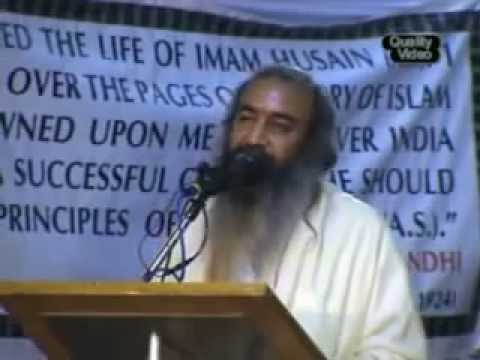
Acharya Pramod Krishnan can easily be described as the most celebrated carrier of inter-faith understanding over Karbala Revolution in modern India where the relation between Hindus and Muslims has remained somewhat strained for the past three decades. A highly reputed scholar of Hindu mythology, Acharya even contested election from Lucknow, unofficial headquarters of Shia Muslims in India, not to win but to promote harmony. He makes it a point to attend any congregation organized anywhere in India to recall the martyrdom of Imam Hussain. He had delivered a much publicized speech at Dargah-E-Shah Mardan in New Delhi after the infamous incident of Dadri that had brought the two major communities at loggerhead.  
Attending the function organized by Anjuman-E-Haidery as a keynote speaker Acharya had extolled the sacrifices made by Imam Husain, saying that he showed what Islam stood for. “Just as the Dadri incident is not the real face of Hinduism, in the same way, the activities of the Islamic State are not the real face of Islam. No one who believes in Islam, and Imam Husain, can commit such acts,” he said, to thunderous applause from the thousands present at, and around, the Dargah.

The loudest cheer from the crowd came when he said that he too was a ‘Husaini’, someone who believed in Husain. He stressed on the fact that Indian Muslims need not prove their love for India to anyone, since this country belonged to them as much as it did to anyone else who lived here. At various points during his speech, the crowd broke into loud chants and Krishnan too joined them.

Anjuman-e-Haideri also passed a resolution which called upon the “International Community to take ‘all necessary measures’ to prevent and suppress its (ISIS) terrorist acts on its territory under its control in Syria and Iraq.

For the people present at the Dargah, this was not only to commemorate the sacrifice of Imam Husain; it was also a way to show that they too stood against the activities of ISIS. Acharya called upon people to show those who love Imam Husain would never endorse the activities of ISIS.
Pramod Krishnan was born on January 4, 1965 in the Tyagi family of Aichoda Kamvoho village in Sambhal. In the name of God Kalki Avatar, the predominance of Lord Vishnu's 10th and final incarnation has been predicted in the beliefs of Hinduism. According to this, in Kalyug, Lord Vishnu will be born as Kalki in Sambhal of Uttar Pradesh. According to calculations, this incarnation will be in the 4,320th century. Along with this, Kalyug will end. Pramod Krishnan is also living in Sanbhal, so he chose Lord Kalki to run an ashram and calls himself “Kalki Pithadishwar’. He has also served as parliamentarian and accused of having embraced Islam out of his sheer devotion to Masoomeen (AS).
In the past one decade, Acharya has delivered lectures on the life and deeds of not only Imam Hussain but also eulogized Bibi Fatima Zehra and Maula Ali at the functions held in Manglore, Kanpur, Bangalore, Lucknow and several other places. He is a gifted poet as well and penned down rhymes in praise of Imam Hussain. His best composition is said to be “Har Aankh Ka Chamakta Hua Tara Hussain Hai”(Hussain is sparkling light of each Eye).(References available on request-Photo Courtesy-Google Images)   

Tazia of Maharani Laxmi Bai


महारानी लक्ष्मीबाई ने सन् 1851 में रखवाया था ताजिया, आज भी कायम है परंपरा
Maharani Laxmi Bai's Tazia in Jhansi

By Dr.Mazhar Naqvi
The love for Imam Hussain in the heart of Maharani Laxmi Bai whose 180th birth anniversary will be celebrated with much fanfare on November 19, 2019, has so far remained unknown to history. Known to the world as warrior queen who opposed tooth and nail the British Empire during the first war of India’s struggle for independence, Maharani had ordered the introduction of Taziadari in front of her palace in Jhansi after her marriage with Maharaja Gangadhar Rao in 1851.The custom still continues “Bai Sahib Ka Tazia” leads Muharram processions in Jhansi.
Described as ‘Joan Arch of the East’, Laxmi Bai was born in temple town of Varanasi as Manikarnika in 1828.She belonged to a reputed but poverty stricken Maratha Brahamin family. She lost her mother Bhageerathi Sapre at the age of 4 and her father Moro Pant relocated himself in Bithoor where Peshva lived in a sprawling palace after being asked to leave Pune. Pant found employment in the court of Peshva Baji Rao in Bithoor about 22 kms from Kanpur City in Uttar Pradesh province of India. Accessibility to royal household enabled Manikarnika, fondly called as Manu, to spend time with Nana Rao, adopted son of   Peshva and Tantya Tope, one of the greatest army general India ever produced.
She was brave and soon expressed her interest in horse riding, fencing and wrestling. She also learnt Persian,Sanskrit and little English as well. She practiced in Akhara(Court) and fought bouts with male wrestlers during annual ‘Dangal’ of Jageshwar Temple in the holy month of Sawan. Once she earned patting from Peshwa for defeating a male wrestler.Peshva liked her too much and called her “Chabilee’due to her jovial nature.
At the age of 15,she tied nuptial knot with the then ruler of Jhansi Gangadhar Rao. She gave birth to a child but he died after four month. Loss of the son left Gangadhar depressed and dejected and he also died .Rani also mourned and adopted Damodar Rao as son. She was aware about Imam Hussain and Taziadari as the first Imambara was built at Bithoor by Chakledar Almas  Ali Khan during the reign of Nawab Asafuddaula in late 18th century. She is believed to have participated in Muharram rituals held at Imambara while living in Bithoor.Even Peshva is stated to have been a regular visitor to Imambara. It should not surprise anyone because Imam Hussain has been quite popular among Marathis. Almost all Maratha kingdoms ensured Tazia processions within the territory under their jurisdiction and even extended royal patronage.
Hence, Maharani like a true devotee of Imam also introduced Taziadari after becoming queen. She used to stay at Rani Mahal near the famous fort of Jhansi. She got erected a platform outside her palace and got a Tazia placed during Muharram. Since then,Tazia has been an integral part of Muharram processions in Jhansi. Considered as a symbol of Hindu-Muslim Unity, Tazia remains source of attractionfor devotees who call it as ‘Bai Sahib Ka Tazia’-a shorter version of Laxmi Bai.
Rani offered floral tributes to Tazia on behalf of kingdom and patronized. Tragically, she lost a decisive battle against the forces of British Commander Hugh Rose at the age of 23.While she is remembered as the warrior queen who gave her life for the sake of freedom ,her Tazia is too revered and allowed to lead Muharram processions as a mark of respect to her and also as her love for the martyr of humanity. (References available on request.Photo Courtesy-Google Images).        

Thursday, 26 September 2019

Beemar-E-Karbala's Relic In Hyderabad


Image result for alava sar tauq hyderabad

Dr.Mazhar Naqvi

Alava(Imam Bargah) Sar Tauq Mubarak in Hyderabad  is an example how the invocation of Imam Zain Ul Abedeen can cure patients. Alava contains in the form of a an ALAM( Standared) made of a piece of shackle that was put around the blessed of Holy Imam by Yazeedi soldiers after the martyrdom of Imam Hussain at Karbala. They had taken him as captive  and made him sit on a lean camel on way to Damascus via Kufa. The relic was brought during the reign of Abdullah Kutub Shah by Haji Agha Mohsin from Syria with proper authentication. The  ruler had received the relic with dsue honors and decreed that it be installed in “Darul Shifa”( Central Hospital) ,stating that the relic was the right place for the relic and its presence will result in speedy recovery of the patients, for it belonged to Beemar-E-Karbala.(Sick Imam of Karbala).He also directed the  one Hoon should be earmarked from the total budget of hospital for offerings flowers and incense before the relic on daily basis.Abdullah did not built a  separate Ashur Khana for  the relic but seventh Nizam did  at after ascending throne. He ordered construction of two rooms and two verandahs on the southern side of Darul Shifa.On 10th of Muharram, Alam is taken out and washed. Devotees collect the water with a firm beliedf that it will cure  their ailments. Being the only relic of its kind in India, lovers of Ahlebait-E-Athaar turn up at Ashurkhana in large number throughout the year. Their numbers swell during Ayam E Aza and reach its zenith on Chehlum Dayi.e.20th day of Islamic month of Safar.

References available on request.

Picture Courtesy :Google Images / Salman Book Center,Hyderabad