Sunday, 10 April 2016

Rare Photograph of Tazia In Nawabi Bhopal

Tazia_Bhopale


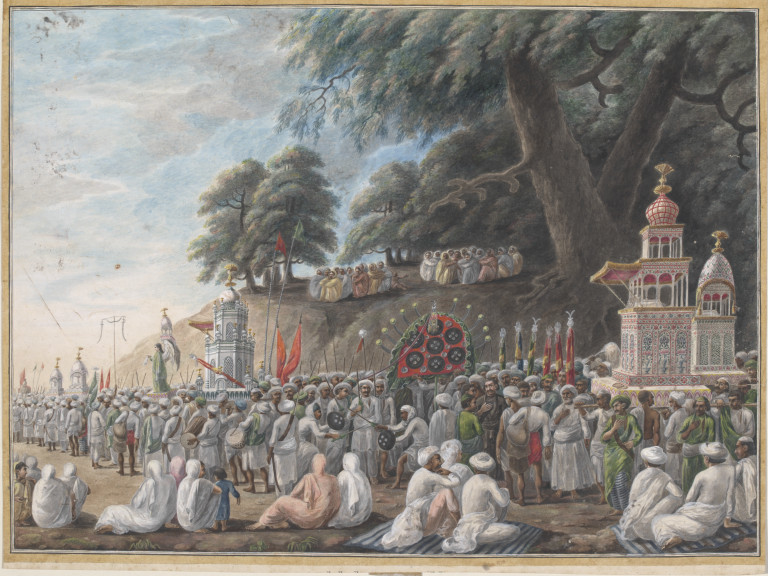
The Muharram at Bhopal: Procession of the Tazias by Louis Rousselet.  In India and its Native Princes, Bickers & Son, London, 1878

Dr.Mazhar Naqvi 

Bhopal, the capital of Indian province Madhya Pradesh, is no longer considered to be a leading centre of Taziadari.But during the rule of Begums of Bhopal, Tazias (replica of the shrine of Imam Hussain at Karbala in Iraq) were taken out with royal pomp and show. Both ruler and ruled, Hindus and Muslims used to pay their respect and tributes to the martyrs of Karbala like many other princely states of British India. An idea about the grandeur of Taziadari in Bhopal can be formed about the portrayal of Muharram observance by Louis Rousselet and brought out by Bickers & Son, London, 1878.In the picture,Tazuia is placed on a richly embellished elephant with well-attired Mahaout. Another elephant follows the elephant carrying the tazia with two attendants.A third elephant also seems to be part of the procession. People are however exhibited rallying around the elephant with tazia placed on it . 

 Apart from religious importance,  Muharram also believed to be at the bottom of the introduction of famous Bhopali Gutka. The Gutka came into existence during the mourning month. The famous Zari Batua (pouch) also originated as a sequel to keep and carry Gutka. Besides Begums, Raja of Islam Nagar Vijay Ram also had a Tazia prepared. Besides making Tazias and holding Majlis several other acts of philanthropy are undertaken. They included offering water and Sharbat, feeding poor and have-nots and distributing alms. The biggest and oldest Tazia of Bhopal is said to be that of Mangalwara eunuchs. The Tazia of courtesan Nanhi Bai was also was also a major attraction before Independence. But when she moved to  Mumbai she took her Tazia with her and the city lost an important constituent of Muharram, ceremonies. In Bhopal, Tazias are made of Bamboo sticks and papers of various kinds.They are  lightweight and eco-friendly as they degrade in water sometime after the submersion. Tazias are mostly submerged in the Upper Lake on the banks of Karbala. But many people also bury them. (Reference Available on request) 


Friday, 8 April 2016

Imam Muhammad Baqir-A Matchless Personality


Dr.Mazhar Naqvi
Greetings to Momneen from Muharram Mirror on the Yaum-E-Wiladat (Birthday) of Imam Muhammad Baqar. His birth was prophesized by Apostle of Allah and his features bore striking similarity to the holy prophet. He had soft skin with moles. Imam had a thin waist, good voice and  always bowed his head. Born to Imam Zainul Abedeen on 1st Rajab, Imam was brilliant  and genius during his childhood. The Companions (of the Prophet) knew that he was  endowed with outstanding merits and abundant knowledge. So, they consulted him concerning the problems which they did not understand.  Everybody respected and admired him. For example, Qatta`da, the jurist of the people of Basrah, met him. His heart trembled because of the Imam's solemnity. He said to him: "I sit before the jurists but my heart does not tremble because of them as it does because of you. 

 Among those who admired the Imam's solemnity included a Moroccan poet, who described him  saying
 “O you who was the son of him by whose tongue and eloquence people were guided and the revelation was sent down. 

The Book talked about his outstanding merits. The Torah and the Bible announced his coming. 

Were it not for the cessation of the revelation after Mohammed, we would say: Mohammed was the alternative to his grandfather. 

He was similar to him in outstanding merits, but Gabriel did not bring him a message.” 

Nobody saw  Imam laughing. When he laughed, Imam  said: "O Allah, do not detest me.He refrained from all that  contradicts solemnity and high character. Among his prominent qualities was that he always praised Allah. The inscription of his ringmstated : "All might is for Allah.He wore the ring of his grandfather, Imam Hussain whose inscription was: "Surely Allah attains His purpose. He  resided in Medina throughout his life. He did not leave it for another city. He served Medina as the first teacher and great pioneer for scientific cultural movements. He used the Prophetic Mosque as school for him to give  lectures to his students.


Imam Baqar was in Karbala also when Yazidi forces slaughtered Imam Hussain and persecuted the survivors. He also suffered pangs of thirst and hunger. His Kurta also caught  fire when tents were set ablaze. Tragic events of Karbala moved him but his faith in Allah remained unmoved and he dedicated his life to spread of knowledge.His sheeer devotion to allah and knowledge earned him the title of Baqar ul Uloom.

Bibi Fatima-Best Woman in Both Worlds

Dr.Mazhar Naqvi
At the outset, I offer my sincere apologies for posting the article on Bibi Fatima a few days after her birth anniversary (Yaum-E-Wiladat).I admit my mistake and don’t want to seek any excuse also. I feel that more than preoccupation with regular assignments, it was procrastination that caused the delay. I might have  skipped to post an article on Bibi even tonight but I decided to post it immediately after finding message on Google+ congratulating Momneen on the birthday of Imam Muhammad Baqar .As I wanted to write an article on the 5th Imam, it dawned upon me that I should write on Bibi first to clear by indebtedness followed by a post on Imam Baqar.

Hazrat Fatima Zahra and Her Excellence
Bibi Fatima Zahra  is the best women in both the worlds, as no lady excels her in love, obedience and nearness to God. Her triple relationship, as daughter of God’s best and last messenger, wife of the first Imam Hazrat Ali and mother of Hasnain and other Imams in her progeny, is another excellence without a parallel. She sacrificed her life in defending the right of her husband to emerge as a perfect model of character for all women to raise voice against any kind of oppression.
Hazrat Fatima was the only woman who accompanied the Holy Prophet t for Mubahila in the challenge against the doubting party, although the holy Quran (Sura 3 : 59) indicated any number of women for the event. This is her yet another matchless excellence.
Imam Khomeini has however considered SAHIFA E FATIMA, revealed to her by angel Gabriel as desired by God to pacify her, as her greatest excellence. It contains the future events and is now possessed by the awaited Imam Mahdi.
The Holy Prophet once asked" what is best for a woman?" People present failed to offer any convincing reply. Then, Bibi gave the reply, "A woman should not see a man who is' namahram' nor a man who is 'namahram' should see her" The holy messenger derived much pleasure from the reply  and declared " Fatima is part of myself." (Fatima baz'ato minni). During the era of Jehaliyat(Ignorance, women were considered as a disgrace and girls were buried alive by their fathers in Arabia. In such an environment ,the last messenger of God was sent for guidance. He always stood up to respect his daughter Fatima to exhibit how believers should treat their  daughters.
According to the Islamic calendar, Hazrat Fatima  was born in the 20th day of Islamic month Jamadi al-Thani, five years after appointment of Hazrat Muhammad as God’s messenger. A wonderful story surrounds her birth. The Holy Prophet was ordered to seclude himself from contact with Khadija for 40 days through a divine command. The Holy Prophet remained in seclusion in compliance. His seclusion was marked by  prayers, fasting, and spiritual connections with his Lord. The Holy Prophet  had sent a courier to Khadija to notify her of the matter and assure her that there was nothing wrong with her and that the event had happened as a result of Allah’s command.
When the seclusion ended, the prophet heard the voice of l Gabriel saying “Allah sends His salaams to you! Get ready to receive the celestial gift from your Lord!” Then angle brought down a tray full of heavenly fruits for the Messenger of the lord  and  said “Eat from this heavenly dish tonight; then go to Khadija; Almighty Allah has willed to create a pure child out of this blissful food.” Allah fulfilled the promise with the birth of Bibi Fatima. An idea about the pure soul and character of Hazrat Fatima can be
formed from some of  her teachings  such as -  God has prohibited Polytheism, so that all people pray to Him alone with sincere love, God has made Patience helpful in attaining its fruits (compensation), God has assigned reward for his Obedience and ordained punishment for His disobedience in order to prevent His obedient servants from His punishment and to direct them towards His Paradise, God has commanded virtues and excellence and prohibited vices and wickedness for general welfare, God has ordered Justice for making hearts intimate & upright and  God has prescribed' Jehad ' for honor and glory of Islam and for disgrace and humiliation of disbelievers and hypocrites.


Monday, 4 April 2016

Rare Painting on Panjatan from India


Dr.Mazhar Naqvi 


The above painting ranks among the rare ones.It shows a Darvesh receiving a visitor at his  place and dates back to 1610-20.The painting belongs to Bijapur School and it has not been yet ascertained as to who is the Darvesh and who is the visitor.For lovers of Ahle-Bait, the painting is important from the point of view of the presence of Alams(Standards) in the left corner.

These Alams prepared in Deccani style contain the names of the Holy Prophet Hazrat Muhammad Mustafa (S),Maula -E-Kaynat Hazrat Ali, Maula Hasan and Imam Hussain.The main flag shown in the painting is also black in color and symbolizes mourning.It is perhaps the only Bijapuri painting with visible names of the infallibles. 

 darvesh refers to someone guiding a Sufi to the  path or " Tariqa",.They live in  extreme poverty and austerity and focuses  on the universal values of love and service, deserting the illusions of ego to reach God. In most Sufi orders, a dervish is known to practice 'dhikr' through physical exertions or religious practices to attain the ecstatic trance to reach Allah. 
Bijapuri school of painting had flourished during Adil Shahi Kings who were great patron of arts.The kingdom also patronized Sufis and some of the emperors professed Imami faith.Hence, influence of 'Shism' is found in the paintings.(References available on request-Image Courtesy Google) 


Tomb of Indian Hindu King Turned Indian Sahabi


Outside View of the Tomb of Cheraman in Salalah(Oman)

Dr.Mazhar Naqvi
Salalah, the historic port city of Oman, has the distinction of having the tomb of the first Indian to embrace Islam. History reveals that the Indian was King Cheraman Perumal of Kerala and had witnessed the miracle of moon splitting with his own eyes, His curiosity to meet the Holy Prophet arose when some Arab traders visited his kingdom and narrated as to how the miracle had taken place. As the King himself had seen the miracle, he joined traders to visit Mecca with them after handing over the authority of his empire to his kin.
In Mecca, he embraced Islam but died in Oman during his return journey. He was buried in Salalah. After performing his last rites, his companions however, reached Kerala with a letter written by the King.His kin and courtiers treated them respect and also allowed them to preach Islam. They  established their faith  in 629AD, the first mosque in India was constructed at Kodungallur.

The tomb of Perumal who had taken the name of Tajuddin after embracing Islam is a popular place of pilgrimage in Salalah and visited by a large number of people. The holy pace is simple in structure but the grave is quite large and covered with richly decorated ‘Chadars’(Sheets). There is a small Masjid beside the tomb and cocoanut trees and gardens in front of it.
(Grave of the India Emperor Cheraman who embraced Islam and considered as a Great Sahabi )


In 2011, a high-level team, as part of the Muziris Heritage Project of Kerala's Ministry of Tourism, had visited the tomb. Former Indian Ambassador to Oman Anil Wadwa had also visited the last resting place of King Cheraman. Though the tomb does not have any kind of restrictions but those willing to visit it are expected to seek permission from the Keralites settled in  Salalah or  Al Baleed area. All the Taxi drivers in Salalah are well aware of the tomb of the great companion of the Holy Prophet in view of its popularity.


Sunday, 3 April 2016

' Ashura Afternoon'-Most Popular Painting


Dr.Mazhar Naqvi
The painting posted above is perhaps the most popular among the admirers of Hazrat Imam Hussain.Originating from Iran, the painting has found entry into majority of the Imami houses in Indian sub-continent.Most of the Imambaras prefer to keep a copy of this painting while decorating them on the arrival of Muharram.  
In Iran,this famous painting  is called as Ashura Afternoon.It depicts the return of Zuljanah,the horse of Imam Hussain from the battle field without rider, indicating to survivors that the grandson of the Holy Prophet has been martyred with three days hunger and thirst on the arid plains of Karbala.
One can easily see in the painting that the wounded Zuljanah is keeping its head low and trying to offer solace to a wailing lady of Hussaini Camp.Other ladies are also see lying on the ground almost unconscious on coming to know about the martyrdom of Imam.It is believed that Ashura Afternoon was first printed in 2009 and taken the Azadar world by storm of popularity due to its emotional appeal based on the theme of post-martyrdom scene of Hussaini Camp.(References available on Request-Photo Courtesy Google Images)

Saturday, 2 April 2016

Muharram in Painting of Sewak Ram


Dr.Mazhar Naqvi 

The above painting was done by a non-Muslim Sewak Ram.He has depicted ,a Muharram Scene of  Patna, the capital of Bihar province of India.It is evident from the painting that Muharram was observed with great solemnity by all sections of society and even women used to take part in the processions.The painting also clarifies that there has not been much change in the design and structure of Tazia and Alams(standards).A number of devotees are also seen observing the ceremony  from a nearby mound with reverence.Considering the population of Patna in 1807, the number of people shown in the painting are quite large in number.There are no  Burqa clad Muslim women but presence of Hindu women is exhibited.The painting proves that Muhammad was observed in early colonial India by Muslims and Hindus alike.(Reference available on request-Photo Courtesy Google Images)