Thursday, 24 September 2015

Eid-Ul-Adha -Festival of Sacrifice with Economic Impact

Eid ul Adha Mubarak 2015 Quotes in English

Dr.Mazhar Naqvi

Muslims all over the world are celebrating Eid-Ul-Adha, popularly known as Bakrid in Indian sub-continent to commemorate Prophet Abraham’s endeavour to sacrifice his own son Ismail for the sake of Allah. The history behind Eid-ul-Adha reveals that Prophet Ibrahim received a divine command to sacrifice his son Ismail. Upon receiving the command, he prepared himself for the sacrifice. Even his son Ismail readily agreed to give up his life when Prophet Ibrahim told his son about the divine instruction. When the Prophet attempted to sacrifice his son, Allah spared Ismail’s life miraculously and replaced him with a lamb. The Almighty Allah also revealed to Hazrat Ibrahim that his "sacrifice" has already been fulfilled, for he had established that his love for Allah superseded all other things.
The Holy Qur'an describes and praises Hazrat Ibrahim: "Surely Abraham was an example, obedient to Allah, by nature upright, and he was not of the polytheists. He was grateful for our bounties. We chose him and guided him unto a right path. We gave him good in this world, and in the next he will most surely be among the righteous." (Qur'an 16:120-121).
To commemorate Hazrat Ibrahim’s  outstanding act of sacrifice , believers  sacrifice a lamb, goat, ram or any other animal on Eid-ul-Adha day. During the celebrations , Muslims commemorate and remember Prophet Ibrahim’s  by themselves slaughtering an animal. The meat of the sacrificed animal is mostly given away to needy. The act symbolizes willingness to give up things that are close to our hearts for the sake of  Allah. It is very important to understand that the sacrifice itself has nothing to do with atoning for our sins or using the blood to wash ourselves from sin. Believers should remember the words of Quran : "It is not their meat nor their blood that reaches Allah; it is your piety that reaches Him." (Qur'an 22:37).The holy books make it very clear that Allah desires from the believers to willingly follow his command completely to purify their  hearts, faith and cultivate a habit of helping those in need.

Apart from social impact, Eid al-Adha also has a massive economic effect in any country with a sizeable Muslim population..Billions of rupees are channelled and redistributed among the people and the poor believers also get a share in the festivities. The festival also helps the rural economy as a large number of people rear Goats and other animals and sells them with profit to those willing to purchase animals for carrying out the sacrifice. The festival also provides skins and hides to the leather industry at a considerably low rate that enables the tannery owners to remain competitive in the global market.

Wednesday, 23 September 2015

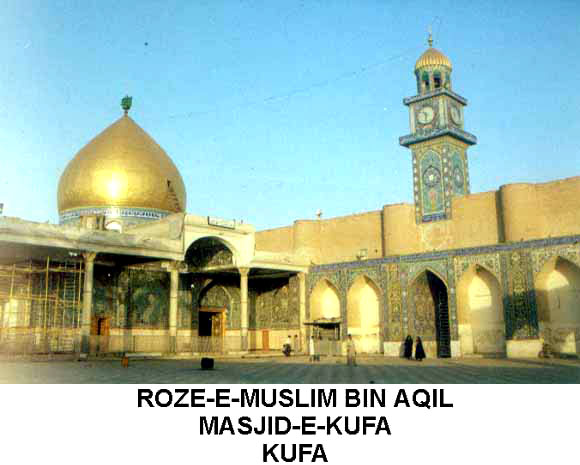
Martyrdom of Hazrat Muslim-Safeer-E-Husssain


(This article is a tribute to First Martyr of Karbala and Emissary of Imam Hussain who is a role model for Ambassadors of all generations)   

Dr.Mazhar Naqvi
Hazrat Muslim is not only the first martyr of ‘Karbala Revolution’. Rather, the way he handled the situation at Kufa before attaining martyrdom puts him as a role model for existing and future emissaries and ambassadors. The basic and most important duty of an ambassador is to represent the interests of his appointee in the best possible manner. These interests shift over time and new developments make his job far more complex than it might appears. A steadfast ambassador stays loyal even in adverse circumstances and does not switch loyalties. It is expected of an able ambassador to deal with different situations, personalities and political undercurrents successfully. He is supposed to manage often less ideal situations and deal with those who do not wish to come to terms. A strong ambassador also needs to be an effective communicator. He needs to speak and enunciate clearly what needs to be conveyed. A good ambassador cares not just about those he represents, but also protects the interests of the people of the area where he has been sent as an emissary.  Hazrat Muslim emerges as an exemplary ambassador when one looks at his heroic deeds after confronted with unexpected developments at Kufa.
It is a well- known fact that the people of Kufa had invited Imam Husain to overthrow the Umayyad rule. The had written : "We are sparing allegiance for you only, we are not attending prayers with the authority’s loyalist, and we ask that you come to us, we are almost one hundred thousand men. Injustice has spread, subjecting us to rules neither provided in the book (Holy Qur’an) nor imposed by its Prophet’s rules. We hope that Allah will allow us to meet with you on the truth, and thus relieve us from oppression. You are the rightful party for the reign, instead of Yazid who had forcefully taken the tax money that belonged to the nation; drinks alcohol, plays with monkeys and lute, and manipulate religion". Imam was on his way to Mecca for the Hajj and preferred to confirm the loyalty of Kufians. He sent his cousin Hazrat Muslim as his emissary to ascertain the situation at Kufa before taking any decision. He arrived in Kufa on the fifth of Shawwal. The admirers of Panjatan flocked to Hazrat Muslim to complain about their sufferings under the Umayyad rule. Whenever such persons approached him, Hazrat Muslim used to read them the letter of Imam Hussain and called upon them:"Do rise with my cousin, pledge him allegiance, support him and don’t let him down!".Such meetings continued until the number of people pledging allegiance to Imam Hussain touched the figure of eighteen thousand. They wept and repeatedly declared “By Allah, we shall hit with our swords between his hands, until we all die". Based upon their allegiance, Muslim sent report about their loyalty and Imam began his journey to Kufa.
So persuasively Hazrat Muslim conveyed Imam’s message to Kufians that when he used to lead prayers at the Mosque of Kufa. 30,000 people followed him. The support garnered by Hazrat Muslim made the ‘Yazidi’ regime apprehensive. Yazid replaced the governor of Kufa and appointed Ubaidullah ibn Ziyad to check the growing following of Hazrat Muslim. The new governor sent his men during evening prayers to announce publicly announcing that anyone found supporting Muslim ibn Aqeel will be tortured and executed. Instead of raising voice against the Governor’s order, Kufians preferred to desert Hazrat Muslim. The impact of Governor’s threat could be gauged from the fact that when Hazrat Muslim finished Maghrib prayers, out of 30,000 only 18 remained with him. After Isha prayers only. Hazrat Muslim found the mosque empty with the exception of the presence of his host Hani Ibn Urwah. The treachery left Hazrat Muslim greatly perturbed. He had only one thing in his mind- how to inform Imam Hussain to stop his journey? On 7th and 8th Zil Hijj, he made desperate attempts to get out of kufa but failed as all the exits were closely guarded by Ibn Ziyad’s soldiers. He also urged people to pay no heed to the threats of Yazidi regime if they wanted to appease Allah. Since only few of among those who had invited Imam were honest and the majority was in a stage of psychological paralysis with their  love and attachment to the worldly life intact, Hazrat Muslims returned to the house of his host with a heavy heart.
After isolating him completely, about 500 soldiers were sent to capture him but Hazrat Muslim outsmarted them with his bravery. He was so strong that he could grab a man with one hand and throw him over the house. Ibn Ziyad sent more soldiers were summoned but Muslim remained inaccessible. Then, they played a trick, dug a pit and covered it with leaves .While fighting ferociously, Hazrat Muslim fell into the pit and was captured. Historians narrate that Hazrat Muslim was badly wounded when he entered the court of Ibn Ziyad. His teeth were broken and blood was gushing out from all over. Yet he entered the court like a 'Lion' and refused to pay any respect to the governor when someone asked , saying “My Amir is only Imam Hussain”. An infuriated ibn Ziyad told Hazrat Muslim that he would be shortly killed and asked him to make his last wishes. The Hashemite Lion replied “I owe a debt which should be discharged by selling off my sword and armor. Secondly I want my body to be given a proper burial. Thirdly I want a message sent to Hussain advising him not to come to Kufa." Ibne Ziyad agreed to the first request but refused to do anything about other two requests. It is also recorded in some narrations that Hazrat Muslim also asked the Governor to spare the life of his host, taking full responsibility of all his actions. Hazrat Muslim remained steadfast till his execution. He never thought of his own death but kept praying for the safety of Imam Hussain. His blunt replies to the absurd questions in the open court made ibn Ziyad so furious that he ordered the   execution of Hazrat Muslim on the roof top of his palace. He remained calm and composed as he was dragged up to the roof top. He kept reciting “Allah-O-u Akbar" till his beheading. Then, his body was thrown to the ground. He was mercilessly killed on 9thof Zil Hijj in 60 AH- just a day before when Muslims were preparing themselves to celebrate the festivities of Eid- al- Hajj. He is buried in Kufa and thousands of people go annually to visit his holy tomb to pay their respects. They visit his shrine, for he strived for the fulfillment of the responsibility entrusted to him by Imam Hussain and sacrificed himself in the cause. His dialogue with Ibn Ziyad, his fearlessness till his last moment and his last wishes not only symbolize his Islamic ethics but also serve as a lesson to modern diplomats as to how should they behave in adversity? (The article has been written as a mark of respect to the first martyr of Karbala Hazrat Muslim on the eve of his martyrdom’s anniversary.Photo courtesy Google Image).   


Tuesday, 22 September 2015

Hajj 2015- Time To Think About Ailing Islamic World Also

 
 A Dazzling View of Hajj-2015( Photo courtesy Google Image)


Dr.Mazhar Naqvi

About three million Muslims are in the Holy City of Mecca to perform the most glorious and sacred ritual of Hajj-2015.The Messenger of Allah Prophet Hazrat Muhammad says: “O people perform Hajj rituals with full awareness and religion and don't come back from Hajj unless you decide to give up committing sins and repent instead.”But who does not know that believers will perform Hajj this year under the watchful eyes of over 1 lakh armed soldiers. The elaborate security arrangements have been made in the wake of the reign of terror unleashed by ‘Islamic State’ (IS).The apprehension of Saudi Government only proves the fact that Hajj, described by Imam Rida as a journey towards Almighty God, is no longer safe from those who claim themselves to be Muslims but defy even the basic tenets of Islam. Does the current situation not propel a true believer to recall what had happened with Imam Hussain in 60 Hijri? He had arrived in Mecca to perform Hajj but had to content with Umrah. He had to leave Mecca as he apprehended grave danger to his life by Yazid’s henchmen who have entered the holy city masquerading as Hajis. Imam later sacrificed himself and his small band of followers at Karbala to save Islam. His sublime sacrifice exposed not only the anti-Islamic activities of Yazid but also drew a permanent line of distinction between right and wrong. Imam Hussain offered everything and suffered persecution in its most cruel and barbaric form to change the mindset of those who were bent upon killing him at the behest of despotic Yazid who is now being imitated by the IS Caliph in speech, action and deeds.

Does not the current situation call for initiation of debate over the real reason of many precepts or commandments of Allah, including Hajj? It has been a problem with Islamic societies to take such commandments at a superficial level despite abundance of religious scholars, preachers and availability of authentic sayings and narrations. As a result, the divine, mystical and spiritual dimensions associated with obligatory pilgrimage like Hajj, to quote Ayatollah Khomeini, becomes “ a hollow worship and a fruitless act”. In one of his speeches, he had pointed out that the most crucial obligations on the part of Muslims was to find out what "Hajj" really is, and why they must always use a part of their material and spiritual possibilities to keep it lively and energetic. The great scholar was indeed accurate in his assessment. Who would deny that the annual Islamic pilgrimage now only symbolizes collective worshipping and excursion-pilgrimage travel? The followers of such philosophy put forward arguments that Hajj has nothing to do with the hardships of believers wherever they are in the world. They also don’t consider it as an opportunity to call Muslims to raise their voice against the silence of Islamic countries towards the sufferings of believers. 

Hajj is a sample of the great religion i.e. Islam, for this collective worship includes monotheism, resurrection, prophecy, Imamate, morality, spirituality, physical and financial worship, cooperation and devotion, interaction, unity, politics, economy  etc. It is a re-enactment of some key events related to the life of Prophet Abraham and his family. Hajj marks the total submission of Prophet Abraham to the will of Allah and rejection of Satan and his ways. Who is not aware that who protects Israel and for what reasons? Who does not know that the most powerful country on earth is like Satan and spreading his ways in poverty stricken pockets of the country? Can anyone deny that the regime responsible for the protection of holy shrines in Mecca and Medina is the most ardent supporter of this strongest nation? So long as we don’t ponder over such questions, Hajj would not be able to inspire Muslims to combat against the materialistic world and restrain themselves from falling prey to Un-Islamic outfits like IS. It is high time for all of us to think how can we stop Hajj from becoming a trip of excursion to see Holy ‘Kaba’ and Masjid –E-Nabwi. If Muslims continue to ignore the divine and mystical reason behind the performance of Hajj, they will remain a neglected, oppressed and anxious lot in third world countries. May Allah protect true believers from the clutches of ‘Satanic nations’ and accept the Hajj of each believer this year.(Amen)            


Friday, 18 September 2015

Khwaja Ghareeb Nawaz Calls With (Shaan) Grace


Syed Salman Chishti(Middle)-Promoting Love,Peace and Through Sufi culture.  

Dr.Mazhar Naqvi

“When Khwaja wants you, he calls you to Ajmer with grace,
Then, he blesses you for your presence at his last resting place,
At his shrine, you feel charisma of Spirituality and Chishtia Hospitality,
And your heart fills with love and a burning desire to serve humanity. “

The blogger has composed the above quadrate based on his conversation with young Sajjada Nasheen of Dargah Khwaja Ghareeb Nawaz Haji Salman Chishti during my recent visit to Ajmer. Though I met Salman Bhai for the first time but the way he received and treated me was enough to prove as to why Chishtia hospitality is considered matchless. Salman Bhai had no information about my arrival as I was not known to him personally. On my way to Ajmer from Jaipur, I suddenly made a call to my Mumbai -based friend Sameer who looks after the activities of Madariya Sufi Foundation and has been ceaselessly working for developing a network of different Sufi orders. Upon coming to know about my Ajmer visit, a delighted Sameer asked me to meet his brother like friend Salman Bhai positively. He described him as a well read person and told me about his lectures on Sufism at the leading universities at the world. He immediately spoke to Salman Bhai, briefed about me and again called me up to let me know Salman was eagerly looking forward to my arrival. I felt touch of Chishtia hospitality when I received a call from Salman Bhai himself to find out how far I was from Ajmer and how many persons were accompanying me. On coming to know I was only a few Kms away, he asked me to SMS by vehicle’s registration number. A few minutes later I received SMS from him that my vehicle has been given security clearance and I can drive right up to Nizam Gate. He also personally spoke to the police official when a lady constable did not acknowledge the clearance due to some confusion.  
To be honest, I had not attached much importance to the entry of my vehicle up to the Nizam Gate. But I soon realized its significance the moment I passed an old gate to find the road leading to Nizam gate full of devotees. Due to congestion most of them were moving close to Nizam gate inch my inch. The moment Salman Bhai saw my car, he waived his hands with excitement from the steps of the majestic gate and immediately sent a youth to escort my group. The moment I thanked him for the trouble he took, he silenced me with a smile, saying “Khwaja Jab Bulate Hain, Badi Shaan Se Bulate Hain aur Phir Aap Ko Koi Aisa tohfa Bhi Zaroor Dete Hain. Sabse Pahle Aap Ziyarat Kijily aur Phir Chishtia Dastarkhwan Ka Maza Lijiye Jo Baise Taskeen-e-Rooh Hoga.” It were these words from his mouth that prompted me compose the quadrate to highlight that whatever Salman Bhai claimed was experienced by me in totality. Despite my unexpected arrival and his awfully busy schedule due to ongoing construction work of his library at Chishtia Manzil ,he remained with my group comprising of my wife Dr.Hena Zaheer, Cousin Meesum Rizvi and a part of my extended secular family Shashank Awasthi and Deepak Kelkar.


He personally took care of offerings to be made at the blessed shrine and then facilitated our stay near the holy grave of Khwaja Sahab in the most relaxed manner. His company allowed us to pay our heartfelt to the Sufi  whose only religion was love and service to humanity. As a descendant of holy Prophet’s family, Khwaja only preached love and strived to mitigate hardships of down trodden throughout his life. His shrine continues to be a source of livelihood to destitute and offers solution to the problems of those who flock to his door step in search of mental peace. Words can never describe the feeling of tranquility one experiences close to his Mazar-e-Aqdas despite huge crowd of devotees and hustle-bustle. My entire group felt the same way and a strange excitement enveloped all of us. Then, we experienced Chishtia hospitality at the house of Salman Bhai and more than the dishes, it was our host’s affectionate request to have more that filled not our stomachs but the heart with immense and unforgettable love for Khwaja and his Khadims who sincerely try to greet each devotee the way Khwaja treated in his life time. Salman Bhai who also showed us personally the attractions of Dargah,is surely carrying on Chishtia legacy and trying to offer love as the only solution to the terror-shattered modern world. It was he who really made me feel that Khwaja Sahab really summoned me to Ajmer. This was my fourth  visit to Ajmer with the first being in 1971 , followed by second in 1989 and third in 1992 when I could not perform Ziyarat due to riot at Ajmer. Since then, I repeatedly made plans to be at the shrine of Khwaja Ghareeb Nawaz but none materialized. Hence, when I found myself finally at the shrine I simply felt a long cherished dream turning into a reality. Then, the words of Salman Bhai removed all my apprehensions when he said ‘Khwaja calls with grace and bless. May Allah bless salman Bhai with a long life and grant success to his ongoing endeavors through Chishtia Foundation to show the true face of Islam . Ameen.    

Thursday, 17 September 2015

Duldul (Horse) by M.F.Hussain


'Muharram-- Painting by M.F.Hussain( Image Courtesy Google)


M.F.Husain Painting a Horse

Dr.Mazhar Naqvi
The 100th birth anniversary of Indian Picasso Maqbool Fida Hussain passed off quietly in his homeland today. Only Google recalled the great painter  befittingly on a day that should have been celebrated at a much grand scale in India. Among the newspaper houses only Indian Express carried some rare photographs of Hussain as a token of remembrance. The apathy towards the hundredth birth day of one of India’s greatest painters only indicate that fanatics neither forgets nor forgives and out of their fear even very vocal personalities prefer to remain silent. Hussain remained star of the eyes of Indian people for decades. But he became an apple of discord by applying his brush to produce some controversial paintings. Husain irked so much the sentiments of a particular community that he had to spend his last days in exile. He breathed his last in Doha in 2011 and was buried there itself. The controversy associated with his name did not die with him. He continues to suffer even after his death as is evident from the shabby treatment given to his 100th birth day.  
Whatever his critics may say, the blogger has no doubt that Husain enjoyed blessings of Masoomeen. His love for ’Duldul(Horse of Imam Husain) and Tazia took him to the zenith of career  as a painter. He was born on September 17, 1915 in Pandharpur(Maharashtra).He lost his mother Zainab at the age of two. Husain himself revealed in an article “  I had fallen seriously ill and her desperate prayer was that her life should be taken and mine spared. That is exactly what happened. Though alive I counted myself extremely unfortunate. Can anyone make up for the loss of a mother? I don’t even have a picture of her. She refused to get herself photographed. In those days people were afraid of the camera. They thought it cast an evil eye and shortened life. Sadly, I have nothing which remotely resembles or reminds me of my mother. She is just a name to me, not even a memory.”
Soon after mother’s death, his family moved to Indore where four years later his father Fida Husain married again. He worked as an accountant in a textile mill. Though he was strict but he encouraged his son’s Passion for painting. Fida was indeed a progressive man as he faced the Indore Ulema who objected to Maqbool’s pursuit, saying “ ‘This is not right. What you are doing is against our religion”.
Husain’s passion for horses, a striking feature of his paintings, also began in Indore. Ashura was a very important day in Indore. It was not perceived as a Muslim festival. Hindus equally participated in the Muharram rituals. Maharaja himself joined the procession every year. “To Muslims, Muharram is not a festival of rejoicing. It is an occasion for mourning the martyrdom of the Prophets grandson Hazrat Husain, who was killed in battle. On the tenth day, Muslims would take out tazias (mobile tombs crafted with bamboo, coloured gilt paper and cloth) in a procession as is customary, and immerse them in the river. The Maharaja’s tazia was the grandest of all—a colossal affair, two storeys high!”
Husain further writes “the making of these tazias was a specialized art. In fact the huge ones took a whole year to make. As soon as they were immersed in water, the craftsmen began to make new tazias for the following year. I used to go and watch them being made......During Muharram they also made huge papier mache horses and painted them. They represented the steed named Duldul on which Husain rode to the wars and was martyred. You know that I am known as the painter of horses. All my life I have drawn horses. My fascination for those glorious creatures began with childhood memories of horses in the procession.”
His words exhibit his reverence for Imam’s horse. Husain was never good at studies. As a young boy, he prayed eight hours a day and his family felt as if he is going to be a Maulvi. But his restlessness for painting led to his ouster from the religious school where painting was a taboo and he had dared to paint the cups and plates.
The ouster from school had no impact on him and his passion for painting became so overwhelming that he lost interest in everything else. “My hand kept moving on paper, making shapes and patterns. I painted on broken bits of crockery and on the floor, imitating the traditions of Gujarat and Rajasthan......As I grew older I got to know more and more about the great painters of the world in Europe, the United States, China and Japan—about Matisse and Renoir, Picasso and Paul Klee.”
 Beginning his career as a painter of cinema posters, he earned worldwide respect and acclamation for his work to be rated as India’s Picasso. But the image of twenty foot high effigies of horses carried during Muharram in Indore remained embedded always in his mind.   
“These gigantic horses signified all the valour of the warrior for the young boy and they emerged in some of his earliest paintings as animated, powerful animals" writes Yashodhara Dalmia in her work on M.F. Husain.

His continued love for Imam’s horse resulted in his emergence as one of the finest painter world ever produced. As his name and fame spread,” his  horse swept across continents, amalgamating various influences into a composite form. He also liberated Duldul from his childhood image first by the Chinese rendering of the horse, and then by the plasticity of form in Franz Marc and Mario Marini's balance between horizontal and vertical lines.” Husain's horses, however, are singularly his own" remarks Yashodhara further.

It may sound strange but it is a fact that so long as Husain remained focused on Duldul he had a Midas touch but when he turned his attention to  a Bollywood heroine and painted Goddesses nude, he had to leave the country that he had refused to part with at the time of partition. Husain remained protected in his early days when Mullahs turned against him but none tried to save him when fanatics attacked him for hurting their religious sentiments through his ‘progressive’ paintings. His life proves once again that if you have once dedicated yourself to the love of Masoomeen, then never try anything else or you would also be forgotten like M.F. Hussain gradually. (This article has been contributed to mark 100th birth anniversary of M.F.Hussain)

Wednesday, 16 September 2015

Hajj and Mughal Emperor Akbar


Extremely rare Photograph of Holy Kaba 

Dr.Mazhar Naqvi
Akbar is the most eulogized Mughal Emperor. Historians have written volumes on his personality, character, victories and religious tolerance. His Deen-e-Ilahi(Divine Faith) too has found enough place on the pages of history. But his contribution to encourage Hajj pilgrimage from India has so far remained a somewhat neglected topic. The blogger thought it appropriate to write on the issue as devotees from all over the world are now very close to perform Hajj. May Allah accept their pilgrimage and protect them from any mishap.(Ameen)   
Akbar was the first Mughal emperor to organize Hajj at state expenses and provided subsidiary to pilgrims. He established a hospice for devotees at Mecca and ordered a caravan to be sent from India every season.he also appointed a senior noble as Mir Hajj and directed his top courtier Abdur Rahim Khan Khana to set aside three of his own ships namely Rahimi, Karimi and Salari for free transportation of pilgrims to port town of Jeddah. He did so after signing a treaty with Portuguese for safe passage of pilgrim ships in Red Sea. These ships weighed between 1400 to 1600 tons with a carrying capacity of 1700 pilgrims each.
Not only this, Akbar’s Mir Hajj carried with him more than Rs.6 lakhs from 1576-1582 AD and goods for distribution among the people of Mecca and Medina. Under Akbar’s instruction, he also carried with him thousands of Khilats(robes of honor) and expensive gifts for the sheriff of Mecca.   
Prior to Akbar’s regime, no Mughal royal lady had performed Hajj. As Akbar ensured safe passage to Jeddah  Bega Begam or Hajji Begam, wife of a noble of Humayun who later became Humayun’s wife became the first to perform, Hajj among the royal ladies. Gulbadan Begam, the daughter of the emperor Babar and aunt of Akbar, Emperor’s own wife  Salima Begam and 40 other women also performed Hajj during Akbar’s period. They  had boarded on ship Salimi and reached  Mecca in 1576 AD after an adventurous voyage .these royal ladies stayed in Mecca till 1582 and performed Hajj four times and Umrah(lesser pilgrimage) several times during their stay in the holy city.
Before Akbar, Indian Muslims had only two options either to travel by the overland caravan or by the ships. Due to various problems associated with land route, most of the pilgrims preferred ships. But the presence of Portuguese pirates in Persian Gulf and Red Sea was too tough and perilous. By entering into an agreement, Akbar removed the danger of Portuguese and made the journey to  Mecca very smooth and exclusive. As the numbers of devotees swelled due to initiatives taken by Akbar, the prime embarkation port at Surat came to be known as known as Bab-ul-Makkah.(Gateway to Mecca)


Protector of 'Najaf and Karbala' - Oudh Bequest


An Old Photograph of Najaf


A Rare Picture of Karbala


Dr.Mazhar Naqvi

Like Khwajasaras (Court Eunuchs), the role of Oudh (Awadh) Bequest in protecting the holy shrines of Najaf and Karbala has also remained a subject of minimal study. Except for the work of Meir Litvak, other historians have overlooked the great role played by Oudh Bequest in not only protecting the shrine of Maula Ali and Imam Hussain but also in preserving Imami seminaries after the plunder of Karbala and Najaf between 1801 and 1810 AD. The bequest had originated from the third Oudh loan extracted by East India Company  from King Ghazi Uddin Haider for Nepal War in 1825.The principal of 10 million was never to be repaid and a fixed yearly interest of 5 per cent was to be applied by the government of India in perpetuity to specific purposes. The stipulated terms and conditions also included monthly allowances for life of Rs.10000, Rs.2500, Rs.1100 and Rs.1000 to four women namely Mubarak Mahal, Sultan Mariam Begum, Mumtaz Mahal and Sarfaraz Mahal. Each woman was also given the power to bequeath one third of her allowance to any purpose she desired. The remaining two thirds together with any portion of the one third if bequeathed by any will from the beneficiaries was to be divided equally and transferred to the Mujtahids residing in Najaf and Karbala for distribution to deserving persons ….. acquirement of religious merit. The bequest became functional after the death of two widows of Ghazi Uddin Haider in April and June 1849.

During the first fifty years of its operation, the bequest channeled more than 6 million rupees with Murtuza Ansari being the first recipient in Najaf. The amount offered much needed economic relief to thousands of Ulema families and students who were living in abject poverty after the repeated raids carried out by Wahabis in early 19th century. The Oudh Bequest also provided means of sustenance to thousands of attendants at the shrines in the twin holy cities. The 1854 distribution agreement reveals  some 1000 members of established families of Ulema ,one thousand Syeds and 600 students as beneficiaries at Karbala alone. It also puts the figure of 1200 students as beneficiaries of the bequest in Najaf. The economic significance of the bequest could be gauged from the words of Murtuza Ansari “ we accepted the funds as many distinguished Ulema families had been reduced to destitution and the need to enhance traditional Imami schooling in view of Wahabi challenge demanded  resources”. It is also worth mentioning here that Ansari withdrew himself from distribution after realizing that the British were using bequest as a ploy to buy influence of Ulema to further their political interest in the region. It is not a hidden secret that the British patronized Wahabis against the weal ottoman empire that has been traditionally been maintaining the holy shrines. Hence, Ansari’s action should be perceived as fully justified. But unfortunately his stand failed to evoke desired response and the British continued their policy with ease. The British appointed Syed Ali as Ansari’s successor.  

Being Imami by faith, the Oudh rulers, their ministers and courtiers always tried to offer financial assistance to the institutions and people associated with them at Najaf and Karbala. Before the bequest, it is recorded in history that between 1786 and 1844 over Rs.1 million were sent to Karbala and Najaf from Oudh for public welfare projects such as the construction of ‘Hindiya’ Canal for brining water from Euphrates to the shrine cities.(Reference available on request)