Wednesday, 16 September 2015

Forgotten Liberator of Bara Imambara

Bara Imambara that remained Under the Possession of British for 27 years before its liberation by Syed Muhammad Ibrahim Sahab.
Dr.Mazhar Naqvi
Bara or Asafi Imambara of Luck now is a world famous shrine. Tourists from all parts of the world flock in large number to see its vaulted structure surrounded by well laid gardens. As a builder of Bara Imambara, Nawab Asaf- Ud- Daula also needs no introduction. But liberator of Bara Imambara Syed Muhammad Ibrahim surely remains unknown to world. It is ironical as well as unfortunate. The efforts of Maulana deserves due acknowledgement as he had to fight for 27 years for the release of the majestic Imambara and the mosques adjacent to it. His achievement becomes more important if one looks at the chain of events and vengeance of the British   after recapture of Lucknow in 1857.
It is a well known fact of the history that British had lost Lucknow to Indian soldiers under the leadership of Begum Hazrat Mahal and her associates. She had proclaimed her son Birjis Qadr as the new ruler of the Awadh. After facing stiff resistance, the British were able to recapture Lucknow. They had to overcome spirited fight put up by Indians at Alambagh, Sikandar Bagh and Qadam Rasul to reach residency. Then they forgot all their decency and deprecated, destroyed  and demolished a number of religious structures. As Indians were led by van Imami Begum Hazrat Mahal, they targeted specifically Imambaras. Since Bara Imambara was the most impressive and a symbol of Imami faith, British exhibited utmost disrespect to it. They turned the Imambara built by Nawab Asaf- Ud-Daula to generate employment during the famine of 1784 into an ‘Astabal’. Soldiers of East India Company walked on its floors with shoes. The British also stopped the performance of Namaz and solemnization of Muharram ceremonies at the Imambara.
Under these circumstances , Maulana Muhammad Ibrahim took up the issue of Imambara’s release. He began his efforts after inheriting  the role of Lucknow’s Peshnamaz around 1868.As Bara Imambara was under the clutches of the British, Masjid Tehsin Ali Khan-built with the leftover  material of Bara Imambara, was being used for holding  congregational prayers. Maulana used his position to safeguard Imami interests against all odds through scholarship, publication and pastoral work. He was a prolific writer and had command over religious matters. He was an issuer of fatwa and his office used to entertain questions from all parts of United Provinces. His simple life and vast knowledge earned him respect from all. He carried out hios religious duties as Peshnamaz and protected muharram rituals at a time when the ruling British regime was keeping such activities under fist control and bent upon curtailing their regal touch associated with processions.
By portraying himself as a reasonable religious leader and scholar, Maulana was in a position to initiate a meaningful dialogue with the authorities by 1880.His persistence and efforts bore results when Bara Imambara was released in 1984 much to the delight of local residents. Since then, Imambara has been serving as the royal initiator of Muharram ceremonies in Lucknow.  (References available on request)


Tuesday, 15 September 2015

Hazrat Ali and Bibi Fatima -Perfect Couple


Dr.Mazhar Naqvi

Heartiest congratulations to all on the wedding anniversary of two sinless beings known to the world as Bibi Fatima Zahra and Maula Ali. They are rightly called as a perfect couple in view of their relationship and dedication to each other as husband and wife. The whopping number of marital problems confronting the modern world can reduce drastically only if married couples start considering Bibi Fatima and Maula Ali as their role model. Relationship means understanding each other without asking. It is like running another mile for your partner. Islam places reliance on mutual love, understanding and caring between the spouses more than the physical needs after ‘Nikah’ (Marriage contract). It also rejects marriage based on materialistic gains and recommends non-materialistic values like level of faith, character and ability to make each other better human being. It is evident from the famous saying of Prophet Hazrat Muhammad “Do not marry a woman for the following four reasons: Wealth, beauty, ancestry and lust. It is obligatory upon you to marry a woman on account of her religion”. On another occasion the Holy Prophet has stated, “There has not been created any institution in Islam which is more favored and dearer to Allah than marriage.” The Holy Quran, itself holds proof of the sanctification of marriage in the eyes of Allah and declares Marry the spouseless among you…if they are poor, God will enrich them of His bounty”

From all the historical accounts available it can easily be concluded that the marriage of Imam Ali and Bibi Fatima was solemnized in strict accordance of relevant laws. It was indeed an ideal marriage, for it was performed by the Prophet himself. In his address (khutba) at the time of marriage, he had declared after introductory remarks “Now in obedience to the Will of Allah . I perform the marriage ceremony of Fatima Zahra with Ali  and ask you to bear witness that I have given  Fatima  in marriage to  Ali  against a dower of 400 pieces of silver coin. May Allah create love between the pair, bless them, purify their offspring, make their progeny a mine of wisdom, and a source of Allah’s blessing and solace to the believers in faith." History later proved that Allah honored each and every word of Prophet’s prayers.

 Imam Ali and Bibi Fatima both lived in a harmonious relationship based on not only faithfulness, obedience and care, but also in soul and spirituality. Hafsa, a daughter of Caliph Umar  and later a wife of the Holy Prophet composed verses to highlight  the greatness of the pair. She says “ Bibi Fatima Zahra  is superior to womankind in the world; she is the lady whose face shines as the full moon; she is the bride whose groom excels all in Scholarship.” Her words truly put Bibi Fatima and Maula Ali as the epitome of the perfect couple. It is recorded in various historical sources that  Imam Ali and Bibi Fatima  used to divide household responsibilities. Their agreement was that Bibi Fatima would grind, knead and bake and Imam Ali would sweep the floor, and bring water and wood for the fire. Is it not a lesson for those men and women who feel shame in serving at home as if working at home is demeaning? This mentality is shattering millions of home and needs to be curbed by creating awareness as how Maula lived with Bibi in complete harmony even in most trying circumstances. Their exemplary relationship is also reflected from the will Bibi made to Imam in her last days when she said “You have not experienced me as a liar or unfaithful and I have not disobeyed you since I have known you”. And Imam replied “You are more pious, God-fearing and knowing for me to rebuke you in anything of that sort.


Some writers have claimed that Imam Ali was extremely poor at the time of marriage and the young couple had to pass days without any fire being lit in their hearth. But neither logic nor rules of Islamic state of that period corroborate such writings. Islam preaches  simplicity and austerity but averse to poverty and wants its followers to earn and lead a comfortable life .If Imam had to sell his Zirah for solemnization of his marriage, it was because of his generosity. Again if the couple had to pass days without food, it was mainly because both never returned any seeker empty handed even if their act left them with nothing to eat. Imam Ali was the greatest warrior of the age. He was also the greatest jurist, grammarian and scholar of the age. He was blessed with spiritual and super natural knowledge. When the Muslims set up a polity at Madina, it was obligatory on the State to provide means of sustenance to believers according to their merits. As Ali surpassed everyone in terms of merits, how could he be so poor as is often portrayed by some writers. Some authors have also given a description of Imam Ali’s house .They have observed that  his bed sheet was so small that it could not cover his entire body. Their account also reveals that Bibi  had to work  hard. The shoulder on which she carried pitchers of water from the well was swollen, and the hands were often covered with blisters ,for she used to work with hand mill to grind corn. It is true Bibi worked very hard as she wanted her husband to work for propagation of Islam with free hand and hence, never bothered him with petty domestic problems. She also worked hard as she never wanted anyone else to burden with her own work. But who could deny that the couple lived harmoniously and bless the world with children like Imam Hasan, Imam Hussain and daughters like Hazrat Zainab and Janab-E- Umme Kulsum who saved the saved Islam at Karbala and created a community that not only offers Mubarakbad on the wedding anniversary of Maula and Bibi but also shed tears on the martyrdom of her sons even at the risk of their lives with cries of “Labbaik Ya Hussain” on their lips.

Monday, 14 September 2015

Can India Save Imamis and Sufism in Gilgit-Baltistan


Victims of Massacre with 'Labbaik Ya Hussain' Written in Urdu on their Coffins. 

Dr.Mazhar Naqvi

All Imamis and followers of Sufism should welcome the latest stand taken by the Indian government over the issue of Pak Occupied Kashmir (PoK).Apart from praising the strong message given by the Home ministry, the admirers of Panjatan should also now strive to develop a global forum that could effectively seek liberation of PoK from extremism and exploitation of its natural resources by outsiders. This is essential or else Imamis and followers of Sufism will be on the verge of extinction in few years. PoK, once part of the princely state of Jammu and Kashmir, has been witnessing mass killings of Imamis and followers of Sufism for the past three decades. Occasionally, these massacres attract the media attention and after a short-lived hue and cry, a strange lull follows to indicate as if nothing happened. PoK, comprising two very picturesque areas namely Gilgit and Baltistan, has abundance of natural resources but about 60 per cent of its population lives below poverty line. Adding to their woes is the growing influence of china in the region that uses the Gilgit –Baltistan as a lynchpin to connect with Pakistan, Middle east and Africa. Another problem of the region is the ongoing efforts of fanatics to marginalize the natives who mostly profess Imami and Sufi faiths. These elements have been repeatedly resorting to raid Imamis, Sufi shrines, Imambaras and other pockets of communal harmony to compel pro-Imami and people inclines towards Sufism to leave their traditional faith, culture and customs, especially rituals associated with muharram and Urs ceremonies. The victims of extremism deserve salute for braving such attempts by keeping their faith intact even at the loss of their lives, property and chastity of women.

By raking up the issue of PoK, the Indian government has brought before the world not only Pakistani possession on the territory of Jammu and Kashmir but also the gross violation of human rights in the region. Over the years, Pakistan has been able to successfully conceal the barbaric treatment being meted out to innocent followers of Imami and Sufi faiths since the days of general zia-Ul-Haque.it was he who at the behest of America began patronizing what was earlier known as Talibanization and is called IS at present. It was again Zia who allowed the use of Madarsas in Pakistan to churn out gun crazy Jihadis to capture initially Afghanistan and then infiltrate into Gilgit -Baltistan for its Talibanization by damaging its centuries old social fabric through mass killings, rape, violence and arson. The natives of PoK continued to suffer as successive Indian governments preferred to remain silent instead of taking initiatives to reclaim PoK. As Pakistan enjoyed the confidence of both America and China, India could never become vocal on the issue even after passing a resolution in the parliament and repeatedly describing PoK as its integral part. Hence, Indian government has surely exhibited the courage to portray PoK as the only issue worth consideration between the two countries. India’s stand would surely provide succor to persecuted practitioners of Imami and Sufi faiths, for Pakistan is now bound to suppress the violent activities of fanatics to show before the world as a nation with zero tolerance policy towards terrorism. Such gesture would offer temporary solution to the shattered natives at least and they would be able to observe Muharram peacefully in October 2015.This will be a great relief to Imamis who have been observing Muharram under the shadow of violence and terror for the past several years. May Allah let it happen, for a long term solution to the plight of natives is still a distant dream and critically depends on the sustainability of India’s stand over the issue.Indian government should remember that more than 62 years have passed since Tribal Infiltrators occupied a  major part of Jammu and Kashmir with the help of newly created Pakistan.Since then,Pakistan has been using the territory the way it wants and India has been either been a mute spectator or restricting itself to statements .There has been no persistence in the policy adopted over PoK issue.Let's pray for the sake of Panjatan's admirers that India remains firm in the saddle.       


Sunday, 13 September 2015

Forgotten Azadar Queen- Qudsia Begum

Qudsia Begum
Dr.Mazhar Naqvi
Qudsia Begum is yet another forgotten and unfortunate azadar. It is so as Imami orators and scholars refrain themselves from recalling her love to Panjatan and contribution to Muharram ceremonies in their narration and writing. Their apathy towards is not deliberate but a result of her character assassination by British historians. Her position as the most ardent admirer of Ahle-Bait among all the Imami Mughal Queens and princes also remains unknown to azadar world due to lack of research work on her life and character. The height of her misfortune could be gauged from the fact that no body knows even the spot where she was buried after her death. It is quite surprising, for Qudsia Begum was not an ordinary woman. She was the third wife of Mughal emperor Muhammad Shah and mother of his successor Ahmad Shah Bahadur. Like NurJahan, she also served as de facto ruler of India. After her husband’s death in 1748, her son Ahmad shah ascended throne. As queen mother, she took the title of Qudsia begum and ruled as regent of her son till 1754.her real name was Udham Bai that indicates that she was a Hindu by origin. She was introduced to Muhammad shah as a dancer and her skills soon captured the heart of the emperor. He grew fond of her and took her as his third wife. He also offered her a high rank in his army that could be used to enforce his rule and maintain his authority, especially during his absence from the capital.
After becoming queen, she could have easily lived like her predecessors Nur Jahan or Mumtaz Mahal who were the favorites of Jahangir and Shah Jahan but did nothing to promote the mission of martyrs of Karbala. While Nur Jahan failed to save Shaeed-E-Salis desp0ite her tremendous influence of Jahangir, there is also nothing on record to reveal that Mumtaz ever did anything to commemorate the tragedy of Karbala. Nur Jahan and Mumtaz despite being Imami with Iranian origin could not persuade Jahangir and Shah Jahan to give due acknowledgement to Muharram ceremonies. They also failed to check the growing influence of orthodox Ulema in the court even though they had remarkably passionate husbands. The task was not difficult for them as well, for Humayun had granted lands for Imam Chowks for placing Tazias during Muharram in the entire kingdom. Likewise during the regime of Akbar, Imamis enjoyed religious freedom and wielded considerable power in the court. But neither Nur Jahan nor Mumtaz who lies buried in Taj Mahal could prevent the Kingdom from slipping into the hands of Ulemas who were averse to Muharram rituals.
The character of Qudsia Begum looks much better as compared Nur Jahan and Mumtaz against this backdrop. After embracing Islam, she preferred to be Imami despite residing in a palace dominated by non-Imamis. As a true follower of Panjatan, she earned the title of Rahamdil Begum by resorting to extensive selfless charity not only to the poor but also to the descendants of a former King who were living in abject poverty and neglect. Her move was different from the established Mughal tradition of killing and imprisonment to those close to previous emperor. Qudsia braved all sort of criticism to advance Nawab Bahadur Javed khan in position and power at the royal court. The elevation of Javed khan gave tremendous fillip to Marasim-e-Azadari in Delhi and produced a breed of eminent marsiyakhwans who made majalis extremely popular among the people of all faiths through their excellent recitation backed by mournful narration of the sufferings of Imam Hussain and his small band of followers.       
She also built the central shrine in Dargah Shah-e-Mardan complex .In his famous book, ‘Isarul Sanadeed’ Sir Syed Ahmad Khan has written” in 1724 Qudsia Begum acquired a stone having a foot impression of Hazrat Ali. Out of her reverence to Imam, she got the stone fixed in a marble ‘hauz’(small Pond) with a marble floor around it.” Entitled as “mistress of the age”, Qudsia Begum is also credited for commissioning exorbitant reconstruction or ornamentation of the complex and the structures at Shah-e-Mardan complex. She also placed at the Dargah the holy relics given to her by Imamis visiting the court of her husband. Qudsia also ensured proper representation of Imamis in Civil and military administration and turned Muharram rituals as lavishly sponsored holy events. Her two contemporary Imami warlords buried nearby – Nawab Mirza Safdarjung and Mirza Najaf Khan, stand nowhere as compared to her contribution to Azadari in the period of later Mughals. 
She also constructed Golden Mosque near red Fort and carried several other works for the welfare of people. It is indeed ironical that such a kind hearted queen and admirer of Panjatan has been portrayed as a lady of shady character and given prominence to her intimacy with Javed Khan without bothering to look into the fact that he was Khwajasara (eunuch).It is high time to carry out research on her so that she is remembered as  a great patron of Azadari, women and the poor and not merely as a dancer whose beauty smitten the Mughal emperor as is usually mentioned by the historians.The effort could also lead to discovery of her grave.As of now it is only known from the account of Maulvi Zafar Hasan that Qudsia Begum had "lost all her influence and was cast into prison and blinded along with her son as early as 1753-54 AD).(References available on request).


Thursday, 10 September 2015

Imambara Built by Nawab Siraj-ud-Daula


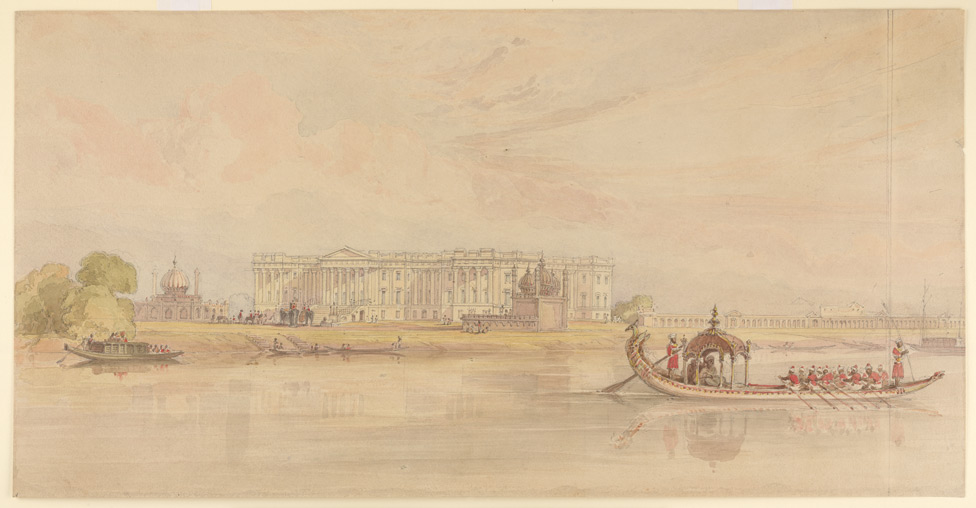
An Old painting depicting Nizamat Imambara in the Extreme Right.(Courtesy Google Image) 

Dr.Mazhar Naqvi

The defeat at the battle of Plassey has overshadowed all the good deeds of Nawab Siraj- Ud- Daula. He is usually remembered by the terms used for him by his vanquisher Robert Clive who portrayed him  "as a monster of vice, cruelty and depravity.” As his defeat marked the beginning of British rule in India, even Indians like the Britons who were responsible to overthrow his legitimate regime consider him as an arrogant, hot headed, impatient and indecisive ruler. Holding such opinion about Siraj is a grave injustice. A careful look at his life reveals that he was victim of betrayal and instead of indecisiveness; he should be blamed for believing people too easily whereas as a ruler, Siraj should have not trusted his own shadow even. Siraj did so and paid a very heavy penalty. He was not only defeated and executed but also failed to get the place he deserves on the pages of history. Instead of being considered as a freedom fighter, he is referred to as a weak ruler whose lack of wisdom paved way for British empire on Indian soil. What an irony? Tipu Sultan did exactly what Siraj did decades before him. But Tipu is remembered with reverence and people flock at his grave near Mysore while Siraj lies in a simple grave besides his illustrious grandfather Nawab Alivardi Khan in Khoshbagh of Murshidabad, former capital of undivided Bengal. Perhaps no one goes to Siraj’s grave to place even a rose bud on his death anniversary on July 2.

Grave of Nawab Siraj- Ud -Daula 
The last Nawab of independent Bengal Mirza Muhammad Siraj- Ud-Daula however shares one strikingly common factor with Tipu. Born to Zain ud-Din Ahmed Khan and Amina begum, daughter of Alivardi Khan in 1733, Siraj also revered ‘Ahlebait’ like Tipu. He even surpassed Tipu in terms of exhibiting his love for Imam Hussain. While Tipu restricted him to issuance of coins in the name of Imams and got the books of his library stamped with the seal containing the names of holy Panjatan, Siraj built a magnificent Imambara in Murshidabad in the most pious manner.  He bought bricks and mortar and laid the foundation of the building with his own hands. The plot where the Imambara was erected was dug up to a depth of 6 feet. It was refilled with soil brought from Mecca so that Muslims unable to undertake Hajj for want of funds could feel the experience of the holy city in Murshidabad. Besides other materials, Siraj however placed heavy reliance on the use of wood in the construction of wood. The structure, known as old Nizamat Imambara survived gracefully and served as a center of Azadari  even after the death of Siraj. But it caught fire in 1842 and a party of Imambara was destroyed. A fire completely destroyed it on December 23, 1846. That unfortunate day, the ruling Nawab along had thrown a party to celebrate the weaning ceremony of five-year-old Hassan Ali Mirza. The Imambara caught fire at midnight due to the fireworks left off to entertain the European guests. Nothing survived except the old Madina Mosque. The fire also gutted the relics that were installed by Siraj at the Imambara.
A new Imambara replaced the one erected by Siraj and destroyed by fire in a record time of 11- months. Nawab Nazim Mansur Ali Khan ordered its construction in 1847 under the supervision  of Sadiq Ali Khan at a cost of more than Rs.6 lacs. The new Imambara is 680 feet long and its central block with Madina mosque is 300 feet long. The new structure was built some feet away from the site of the old building in north. The Imambara today is considered to be one of the largest in the world and stands opposite to the Hazarduari Palace on the banks of the Bhagirathi River. It becomes the hub of mourning ceremonies after the sighting of Muharram moon every year. (References available on request.)


Sunday, 6 September 2015

Hussain Sagar and Its History


Hussain Sagar -Hyderabad(India)

Dr.Mazhar Naqvi

The Telangana government's ambitious plan of emptying, de-silting and refilling Hussain Sagar Lake with fresh water in Hyderabad is a praiseworthy tribute to a Hussaini Syed. The lake was built by a revered Sufi of Chishtia Order Hazrat Hussain Shah Wali in1562, during the rule of Qutb Shahi King Ibrahim Quli. It covers a total area of 5.7 square kilometers.

Shah Wali was a revered Sufi of Golconda. His patronymic name was Abdullah and title Nasir Uddin. But he is famous as Hussain aka Hussain Shah Wali due to his sheer devotion and love for Imam Hussain. He belonged to a Sadaat family tracing its lineage to Imam Hussain and through some connection was also linked with Khwaja Banda Nawaz Gesudaraz whose ardent love for Ahle-Bait is well-known like the Chief patron saint of the Chishti order in Indian sub-continent Khwaja Moin Uddin Chishti Ajmeri. Shah Wali’s ancestors were caretaker of Banda Nawaz’s shrine in Gulbarga.

Being brought up in the surroundings of holy shrine of Banda Nawaz, he developed leanings towards Sufism from an early age. His name and fame as a saint with miraculous power spread quickly. Initially, he resisted the temptation of being a part of worldly affairs and even discouraged people to visit him. But destiny brought him to Golconda. Even though he was not Imami by faith, Shah Hussain received a warm welcome upon his arrival at Golconda. The Imami king Ibrahim Qutb Shah sent his ministers and senior officials to bring Shah Wali to his court with great honor. The knowledge, conduct and behavior of Shah Wali impressed the king to the extent that he offered him in the very first meeting a mansab of ‘Das Hazari’ (Commander of 10,000 troops).Ibrahim Quli also appointed him  the post  of royal construction works. Later on, Ibrahim Quli accepted him as his son in law and married his daughter Khairat Unnisa Begum with him.

Despite bestowed with royal honors and vast estates, Shah Wali always took care of needy and began construction of Hussain Sagar as a permanent solution to the water problem of the area. He arranged the permanent feeding of the Sagar from river Musi. The ruling Sultan wanted to name the lake under construction after his name but people preferred to call it as Hussain Sagar. Ibrahim Quli Shah then constructed another Sagar in another area and christened it after his name as a mark of respect to sentiments of people to associate the newly built Sagar with the name of Hussain. Since then, Hussain Sagar has been an integral part of Hyderabad and its residents.

After offering fresh and clean water to people for centuries, Hussain Sagar also became victim of industrialization and urbanization. Successive governments overlooked its deterioration and it is estimated that   Hussain Sagar has about 45 lakh cubic meters of silt now. Its full tank level is 513.14 feet, against which 512 feet water is only available.
Hence, it is indeed a welcome move of Telangana government to restore Hussain Sagar to its original form. The step deserves to be treated as a befitting tribute to a Hussaini who lies buried in a shrine built by Abdullah Qutb Shah. His Dargah rises to a height of 50 feet with a square structure built in Arabic style of architecture. Its dome is round and people from all faiths and walks of life visit his shrine for fulfillment of vows and to pay their respect to the Shah Wali. A poet composed a couplet in Persian that reveals the year of his Purdah (death).The couplet reads:
‘Rafaft Az Duniya Hussain Pak Deen.’ = 1068 A.H.(Hussain Left the word and who has pure religion.)


Dargah Hussain Shah Wali-Hyderabad(References available on request)

Saturday, 5 September 2015

Azadar Javed Khan- Forgotten and Unsung


Grave of Nawab Bahadur Javed Khan 


Dr.Mazhar Naqvi
Nawab Bahadur Javed Khan is yet another forgotten azadar of Mughal India. His contribution to the promotion of Azadari in Delhi has remained a subject of minimal study. Western and Indian historians have preferred to portray him as a completely illiterate Khwajasara(Eunuch)  with no knowledge of administration and attributed his rise to power to his pampering the emperors ‘vices’ and humoring the queen Qudsia Begum, popularly known as Rahamdil Begum. His personality looks altogether different and he emerges as a great azadar when one refers to his description in the account of Dargah Quli Khan’s ‘Muraqqa-e-Delhi’ .Khan had stayed as member of Nizam Ul Mulk Asaf Jah’s entourage in Delhi from 1739-41 written his observations about life and culture of people in his personal diary. His accounts reveal that Javed Khan had erected an Ashurkhana where noted marsiyakhwans Mir Lutf Ali Khan used to recite elegies during Muharram. Mir Lutf was also entrusted with the responsibility of making arrangements for ‘majalis’ and treating the mourners with utmost care. It is also mentioned that Mir Lutf used to recite marsiyas and ‘manqabats’ from the ‘Diwan of Javed Khan.
 Javed Khan was the assistant controller of imperial ‘harem’. After Ahmed Shah, son of Qudsia Begum, ascended throne, Javed Khan earned phenomenal rise. The King raised him as  6 Hazari mansab with title as Roz-afun Khan( superintendent of the harem). Soon after Ahmad shah  elevated him further and gave all real power to him as the Superintendent of Diwan-i-Khas. The new position gave him power to control the entry of court councilors and confirm the appointments (arz-i-mukarraro). He even controlled the estate of Begums and Privy Purse of the emperor. He became 7 Hazari Mansabdar and bestowed with the title of Nawab Bahadur( Emperor’s Vicar). He was given insignia of the highest honor, ‘ Mahi-o-Maratib’, standard, banner, kettle drums and a fringed ‘Palki’. The Khwajasara attained such exaltedness that no noble could compete with him.


His growing power proved fatal for him. Nawab Safdar Jung who was also Persian like Nawab Bahadur, found Khwajasara’s immense influence on emperor and queen mother averse to his own political interests. He allegedly got Javed Khan assassinated in August, 1752.Nawab Bahadur lies buried in Shah-E-Mardan complex .His grave is simple and stands on a double platform. The lower platform is built of red sandstone while the upper is of marble. Those who visit the holy complex dedicated to Maula Ali are mostly ignorant of Javed Khan and his contribution to Azadari during later Mughal period. Historians may portray him as a sycophant but his immense contribution to Muharram ceremonies and patronage extended to marsiyakhwans in an era of chaos and court intrigues cannot be ignored and overlooked. 

It was his persuasion that filled the heart of Qudsia Begum with ardent affection for Ahle-Bait after she embraced Islam upon becoming a consort of King Muhammad Shah as ‘Udham Bai’. During the lifetime of her husband and son, Qudsia Begum did her best for propagation of Muharram and decorated Shah-E-Mardan with the handprint of Maula Ali. Under her influence, even Muhammad shah and her son Ahmed Shah also indicated Imami leanings in their conduct.Further, Javed also erected an Ashurkhana(Imambara) in his haveli near Delhi gate. It is worth mentioning here that Safdar Jung also used to organize majalis at his palatial palace but he is not credited with the commissioning any Imambara. It is ironical that research activities about azadars like Javed Khan are not being undertaken. As a result, Zakirs too remain ignorant about them and don’t mention their contribution from pulpit while addressing mourning assemblies. From this perspective, Dargah Quli Khan deserves full praise for observing and recording the life and culture of Delhi during his stay there from 1739-41 as member of the entourage of Nizam- ul- Mulk Asaf jah1.Had he not mentioned Javed Khan’s Ashurkhana, Mir Lutf khan as organizer of majalis and recitation of marsiyas from his Diwan, Javed Khan would have remained unknown forever.(References available on request).